Annual analysis from Sovos ShipCompliant and WineBusiness Analytics shows steep losses in volume and value amid wider wine industry slowdown
ATLANTA, Jan. 27, 2026 /PRNewswire-PRWeb/ -- Mirroring broader challenges across the wine industry, new findings from the annual Direct-to-Consumer Wine Shipping Report from Sovos ShipCompliant and WineBusiness Analytics indicate that the prolonged downturn in the DtC wine shipping market intensified in 2025.
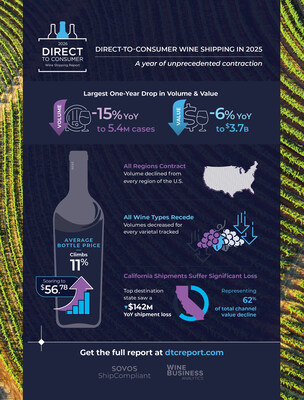
Marking the most challenging year since the report's inception in 2010, 2025 saw record drops in both the volume and value of DtC wine shipments. The DtC winery shipping channel contracted by 967,000 cases and more than $230 million in 2025, a 15% drop in volume and 6% decrease in value, respectively. These results come as the channel saw an 11% increase in the average price per bottle shipped.
"We had hoped the DtC shipping market might be approaching a period of stabilization. Unfortunately, the data tells a different story," said Alex Koral, regulatory general counsel, Sovos ShipCompliant. "Not only did the DtC channel continue to contract, but it did so at a faster rate than we've ever recorded. The DtC channel has historically amplified broader market trends, and what we're seeing in 2025 is a clear signal that DtC is not insulated from the headwinds facing the wine industry. It may, in fact, be feeling them more acutely."
The forces weighing on wine sales are numerous and well documented, and while the report does not seek to assign a single cause to the downturn, it places the DtC shipping decline firmly within the context of the macro pressures facing the U.S. wine market. Sales data from both on-premise and off-premise channels show declines in 2025. However, a sharp drop in DtC shipments indicates that while the channel outpaced the overall wine market during years of growth, it is now contracting at a faster rate than other purchasing channels.
"The DtC shipping channel has been suffering from a structural decline for the past four years. Early on in this period, we could attribute this decline to the reverberations of the Covid pandemic. That event no longer explains the current moment, just as it can't explain the overall decline in the U.S. wine market," added Andrew Adams, analyst and editor, WineBusiness Analytics. "Fewer consumers are receiving wine shipments from wineries. No element of the industry has escaped the impacts of this reality."
Additional key takeaways from the 2026 report include:
- Largest wineries suffered the most in DtC shipping downturn: The largest category of wineries, those producing more than 500,000 cases annually, saw a 23% decrease in the volume of wines shipped direct-to-consumer, greater than any other winery size category.
- All wine types declined in volume of shipments: No wine type escaped the downturn in shipments in 2025, with every wine tracked by the report showing lower volumes from 2024.
- Napa wineries held steady on value of shipments: Despite lower volumes, Napa County wineries outperformed other regions by adding 1% to the value of their DtC shipments in 2025 and losing 8% of volume, far below the overall shipping market's 15% volume decline.
- California shipments suffered a significant decline: Napa's resilience stood in contrast to steep losses in California—the most common destination of wine shipments—overall. The state experienced $142 million in lost shipments, accounting for 62% of the channel's total loss in value in 2025. Outside of Napa, the Rest of California region experienced a drop in volume of 32%, resulting in a 47% decline in the volume of shipments from Rest of California since 2021.
- The least expensive wines experienced the largest loss in volume: The 2025 data confirms that purchasers of lower-priced wines are buying less and dropping out of the DtC shipping channel in greater numbers than buyers of higher-priced wines. Contrary to the narrative of premiumization, in which buyers trade up from lower- to higher-priced wines, this "mix-shift" sees higher-priced wines capturing a larger percentage of the DtC shipping market as there are fewer buyers of lower-priced bottles.
"What happened in DtC shipping in 2025 wasn't subtle or selective—it was systemic. While many of these market shifts and economic conditions are outside the wine industry's control, consumer engagement is not," added Koral. "Tasting room traffic is the engine that fuels DtC sales, especially when the market is under pressure, by motivating purchases, wine club memberships, and long-term customer relationships. Those fundamentals remain the foundation of a strong DtC shipping channel."
The Direct-to-Consumer Wine Shipping Report is an annual collaboration between Sovos ShipCompliant and WineBusiness Analytics, examining shipment trends from wineries to U.S. consumers. The proprietary data included is compiled from an algorithm measuring total DtC shipments based on millions of anonymous direct shipping transactions filtered through the ShipCompliant system and paired with WineBusiness Analytics' comprehensive data on U.S. wineries, resulting in the most accurate depiction of the DtC wine shipping market. The report provides a comprehensive analysis of these trends and serves as a critical benchmark for wineries, retailers, and industry stakeholders navigating a period of sustained structural change in the wine market.
To read the full 2026 Direct-to-Consumer Wine Shipping Report, including analysis by size, region, varietal, time period, destination, price, and more, visit dtcreport.com.
Sovos is transforming tax compliance from a business requirement to a force for growth. Our flagship product, the Sovos Compliance Cloud platform, enables businesses to identify, determine, and report on every tax obligation across the globe. Sovos processes 16 billion+ transactions per year, helping companies scale their compliance strategy in almost 200 countries.
More than 100,000 customers – including half the Fortune 500 – trust Sovos' tax and regulatory expertise and unparalleled integration with their business applications. Learn more at sovos.com.
The leader in automated alcohol beverage compliance tools for 20 years, providing a full suite of cloud-based solutions to wineries, breweries, distilleries, importers, distributors and retailers to ensure they meet all federal and state regulations for direct-to-consumer and three-tier distribution. ShipCompliant's solutions reduce risk, lessen the burden of compliance, accelerate bringing products to market and enable revenue growth. With 60+ partner integrations, Sovos ShipCompliant leads a robust ecosystem of technology partnerships, enabling powerful complementary solutions. For more information, visit https://sovos.com/shipcompliant and follow us on LinkedIn.
The WineBusiness Analytics team maintains the wine industry's most accurate databases and provides data-driven analysis, data, insights and reports to help clients grow and manage their businesses. For more information visit www.winebusinessanalytics.com.
Media Contact
Abby Cohen (Rosen Group), Sovos ShipCompliant, 1 9732240403, [email protected], https://sovos.com/shipcompliant
SOURCE Sovos ShipCompliant



Share this article