Independent lab testing commissioned by Cata-Kor found that one berberine supplement bought on Amazon contained no detectable berberine and three more delivered 5% of their labeled dose or less. The study is the second in Cata-Kor's label-accuracy series, following its June investigation of glutathione supplements.
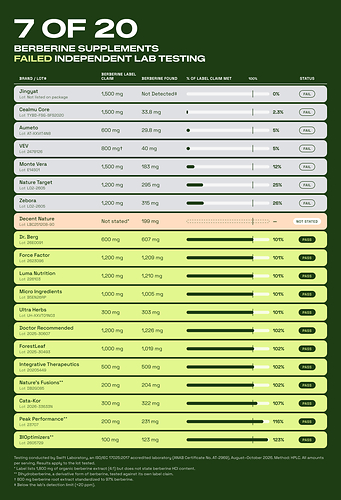
MIAMI, Nov. 5, 2026 /PRNewswire-PRWeb/ -- Seven of 20 berberine supplements contained far less berberine than their labels state, according to independent testing commissioned by Cata-Kor, a U.S. longevity-focused nutraceutical company. One product had no detectable berberine at all, and four delivered 5% of the stated dose or less.
Nineteen products were selected from Amazon.com search results for the keyword "berberine," and Cata-Kor's own Liposomal Berberine was tested alongside them. All were tested by Swift Laboratory, an ISO/IEC 17025:2017 accredited lab in Ontario, California, using HPLC. Twelve products met or exceeded their label claims. One product did not state its berberine content on the label and could not be rated.
Key findings
- 20 berberine supplements tested, one unit of each
- 7 failed to meet their label claims
- 4 of the failed products delivered 5% of the stated dose or less
- 1 product contained no detectable berberine (claimed 1,500 mg per serving)
- 12 products met or exceeded their label claims
- 1 product did not disclose its berberine content on the label
- 0 samples failed microbiological screening
Products that failed
Seven products contained between 0% and 26% of the berberine stated on their labels:
- Jingyat (claimed 1,500 mg): no detectable berberine
- Cealmu Core (claimed 1,500 mg): 33.8 mg, or 2.3% of the claim
- Aumeto (claimed 600 mg): 29.8 mg, or 5%
- VEV (claimed 800 mg): 40 mg, or 5%
- Monte Vera (claimed 1,500 mg): 183 mg, or 12%
- Nature Target (claimed 1,200 mg): 295 mg, or 25%
- Zebora (claimed 1,200 mg): 315 mg, or 26%
For Zebora, the lab also recorded that the total powder in a two-capsule serving weighed 893 mg, while the ingredients listed on the label add up to 1,320 mg.
Jingyat, the product with no detectable berberine, came without an outer box, and its packaging showed no lot number or expiration date.
Decent Nature lists 1,800 mg of organic berberine extract (4:1) per serving but does not state how much berberine the extract contains. Testing detected 199 mg of berberine HCl per serving. However, without a specified amount of berberine per serving on the label, we could not determine whether the measured amount met the label claim.
"Someone who buys a 1,500 mg berberine supplement and gets almost none of it has no way to find out. They take it for a couple of months, see no change, and decide berberine doesn't work for them, while the bottle keeps selling," said Vlad Seuruk, CEO of Cata-Kor. "After the glutathione results we expected berberine to be next in line, because demand has grown so fast. Most of the products we tested hit their numbers, which shows that accurate dosing is entirely achievable."
Products that passed
Twelve products met or exceeded their label claims: Dr. Berg, Force Factor, Luma Nutrition, Micro Ingredients, Ultra Herbs, Doctor Recommended, ForestLeaf, Integrative Therapeutics and Cata-Kor Liposomal Berberine, as well as three products containing dihydroberberine, a derivative form of berberine, which were tested against their own label claims: Nature's Fusions, Peak Performance and BIOptimizers.
All 20 samples passed microbiological screening, including tests for E. coli, Salmonella, yeast and mold.
Cata-Kor Liposomal Berberine
Cata-Kor's own Liposomal Berberine, which launched in November on the Cata-Kor website, Amazon, TikTok Shop and Walmart.com, was tested by the same lab using the same method and met its label claim. Each two-capsule serving contained 322 mg of berberine HCl against a 300 mg label claim (107%). The formula also met its claims for chromium (234 mcg against 200 mcg) and gymnema leaf extract (342 mg against 300 mg), and arsenic, cadmium, lead and mercury measured well below USP <2232> limits.
"We put our own berberine through the same test before it reached a single customer," said Seuruk. "Hitting the number on the label is the starting point for a supplement, and we would rather prove it with a lab report than ask people to trust us."
Methodology
Nineteen products were selected from Amazon.com search results for the keyword "berberine." One unit of each product was purchased on Amazon.com in August and September 2026 and shipped directly to Swift Laboratory (Ontario, California), an ISO/IEC 17025:2017 accredited laboratory (ANAB Certificate No. AT-2969). Berberine and dihydroberberine content were measured by HPLC, and all amounts are per serving as defined on each product label. Results apply to the specific lot tested.
The study was commissioned and funded by Cata-Kor. Cata-Kor's own product was tested separately by the same laboratory in October 2026 using the same method. Lab reports are available on request.
The study is the second in Cata-Kor's independent testing series. In June 2026, the company published results showing that 6 of 12 top-selling glutathione supplements on Amazon failed to meet their label claims.
About Cata-Kor
Cata-Kor is a U.S.-based nutraceutical company developing longevity formulations that support cellular health, vitality, and daily performance. Its portfolio is built around cellular energy mechanisms and healthy ageing pathways. Cata-Kor has a manufacturing facility in the United States and conducts all testing domestically, with a focus on transparency, quality, and science-informed development. Learn more at catakor.com.
Media Contact
Anna Sivukha, Cata-Kor, 1 7744838381, [email protected], Cata-Kor
SOURCE Cata-Kor

Share this article