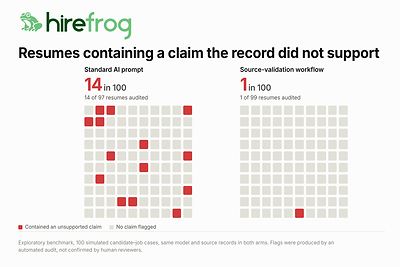
Job seekers are turning to AI to tailor resumes to each posting, but a recent evaluation by AI company HireFrog shows the risk candidates face when using this approach. In a simulated test, an AI model prompted to be accurate still added statements that the candidate's work history didn't support about 14 of 97 cases. For a candidate, that means a high likelihood that fabricated claims can be surfaced during an interview or background check.
NEW YORK, Nov. 11, 2026 /PRNewswire-PRWeb/ -- Job seekers using AI to tailor their resumes may be submitting claims their own work history does not support, according to results published by HireFrog, a job-application software company.
In an exploratory benchmark of 100 simulated candidates, a single accuracy-focused instruction to an AI model produced resumes that an automated audit flagged for unsupported factual claims in 14 of the 97 resumes audited, roughly one in seven. The same model, run through a structured research workflow that mapped each claim to a source record and verified it before output, produced one such case among 99 audited resumes.
The test covered one model generating the resumes, under one set of instructions, and does not describe the behavior of AI writing tools generally. The workflow was a research implementation built for the study. It is not yet part of the HireFrog application.
"We tested a verification step because we thought one was missing," said Eric Walker, Head of AI at HireFrog. "The benchmark gave us a first measurement of what the full workflow can do, and we're building it into HireFrog."
Surveys have measured how many job seekers would knowingly embellish a resume with AI. This research measures something different: what the tool adds on its own, to someone who asked it to be accurate.
The flagged statements were not dramatic inventions. One described "cross-functional collaboration" where the source record documented only colleague training. In HireFrog's view, none would be obvious to someone skimming a document the AI just wrote, and all are the kind of claim an interviewer could probe.
"A resume is a factual document. Anything that helps write one has to meet that standard. Accuracy isn't optional, it's foundational," said Walker.
Roughly two-thirds of candidates report using AI when they apply, according to Career Group Companies' 2025 Market Trend Report. A 2025 working paper by researchers affiliated with Yale University analyzed five million cover letters submitted on Freelancer.com. It found that more than 75% of AI-assisted letters were finalized within one minute of the tool being used, and that after the tool launched, the correlation between a letter's textual alignment with a job and the callbacks it received fell by 51% (arXiv:2509.25054).
HireFrog's position is that the problem is an unverified process, not dishonest users. A common approach is to ask a model to rewrite a resume against a job posting in one step. The research workflow breaks that into three: map every requirement in the posting to specific evidence in the candidate's record, marking gaps rather than filling them; draft only from that mapping; then validate every statement against the original record before the candidate sees it. HireFrog is developing this workflow for its application. Today the application generates tailored resumes in a single step, with instructions to use only the candidate's documented facts, and does not include the validation step.
Beyond tailoring, HireFrog scores how closely a candidate's documented experience matches a job's stated requirements, marking each requirement as evidenced or not, so candidates can judge a role before they apply. The platform is a web application and also offers a Model Context Protocol (MCP) server, which lets users start a tailoring request from inside Claude, ChatGPT, and other MCP-compatible assistants. Neither feature was evaluated in this research.
Methodology and limitations: The study is exploratory and tested a research implementation of the workflow, not the deployed application. It ran on a different AI model than the application currently uses. It used 100 simulated candidate-job pairs and synthetic records rather than real work histories, and was conducted by HireFrog, which has a commercial interest in the result. Its audit flags were AI-generated without human review, and some involved debatable readings of sparse records. The study's prespecified primary question, whether tailoring method changed which candidates a simulated screener shortlisted, found no difference between methods. The accuracy comparison reported here was analyzed afterward. This is a working paper and has not been peer reviewed. The full paper, including methodology and results: When Resumes Don't Tell the Whole Story
About HireFrog
HireFrog builds AI-enabled job-application software that helps candidates find roles, tailor their applications, and manage them in a single workflow, built around the candidate's documented experience.
Learn more: www.hirefrog.co
Read the full paper: When Resumes Don't Tell the Whole Story
Media Contact
Media Relations, HireFrog, 1 4808407171, [email protected], www.hirefrog.co
SOURCE HireFrog

Share this article