Adjustments to earnings remain widespread across Corporate America. S&P 500 companies routinely report "adjusted earnings." Just how much companies are adjusting, and the substance of those adjustments, are the subject of a comprehensive annual Non-GAAP Reconciliations Report from Calcbench, in collaboration with Suffolk University's Sawyer Business School
NEW YORK, July 16, 2026 /PRNewswire-PRWeb/ -- Calcbench, a leading interactive platform for financial data from SEC filings, in collaboration with Suffolk University's Sawyer Business School, today released its most comprehensive study to date on non-GAAP adjustments companies make to corporate earnings.
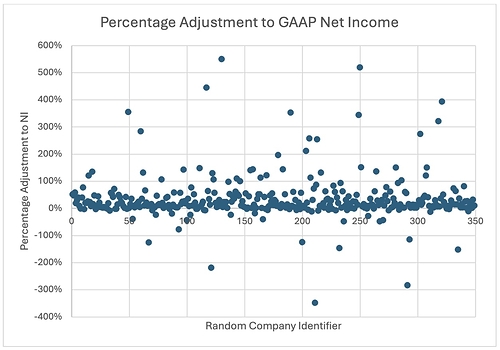
The study identified 361 S&P 500 companies that adjusted their net income or EPS figures for their fiscal year 2025 earnings. In total, the firms reported adjusted net income that was $271 billion higher than "traditional" net income as defined by Generally Accepted Accounting Principles (GAAP).
Eighty-seven percent of firms had adjusted net income that was higher than GAAP net income, and some firms (AbbVie, Broadcom, Capital One, General Motors, and Pfizer among them) reported adjusted net income that was multiple times higher than GAAP net income. Those companies' adjustments were so substantial that they contributed materially to the $271 billion in total non-GAAP adjustments across the whole S&P 500.
This marks the fifth year that Calcbench and Suffolk University have collaborated to examine how the largest U.S. public companies adjust their U.S. Generally Accepted Accounting Principles (GAAP) figures to measure profitability. One of the most notable findings from this year's research was a significant shift in adjustments related to gains and losses on investments. In 2025, companies' total adjustments for investments were negative $7.9 billion (meaning companies removed investment gains from their adjusted income figures), which was a $33.5 billion swing from the positive $26.5 billion reported in 2024.
"The removal of gains and losses from investments begs the question of exactly how big these corporate investment portfolios are becoming," says Pranav Ghai, Co-Founder and CEO of Calcbench. "But analysts and investors still need to assess whether these non-GAAP adjustments provide a clearer picture of earnings."
"Whether or not you believe the adjustments are warranted, analyzing non-GAAP remains a critical part of understanding management's perspective of company performance," says Tracey Riley, Interim Dean of Suffolk University's Sawyer Business School. "Suffolk University's Sawyer Business School Winterns' work spanned multiple courses, where they collected and reviewed data, and conducted in-depth analyses of the adjustments."
Click here for the full Non-GAAP report.
Calcbench is a financial data platform designed for outperformance. Founded in 2011, the company uses the latest technology to offer instant and systematic access to all the data (numbers and text) in financial statements, including the details hidden within the footnotes. Developed by former analysts and supported by a team of financial experts, Calcbench was built for data analysts looking to go deeper. Visit http://www.calcbench.com to learn more.
Suffolk University's Sawyer Business School offers a rigorous business education—with purpose. The school occupies an unrivaled position at the nexus of Boston's private, public, and nonprofit sectors. Our learners enjoy unparalleled access to the city's financial and innovation clusters, seats of government, nonprofit organizations and world-class healthcare institutions. Leveraging our distinctive location, multidisciplinary programs, world-renowned faculty, and immersive educational experiences, we empower our graduates to become innovative change agents who positively impact society at the local, national, and international levels.
Media Contact
Samantha Berg, Calcbench, 1 9175334622, [email protected], calcbench.com
SOURCE Calcbench

Share this article