
Four APILayer APIs turn an ordinary website visit into location, device, currency and weather information, without cookies, forms or consent banners.
AUSTIN, Texas , Sept. 28, 2026 /PRNewswire-PRWeb/ -- Every time somebody opens a website, the visit brings two small pieces of information with it. The first is the internet address it is coming from. The second is the browser being used and the device it is running on. Neither is asked for. Both arrive on their own.
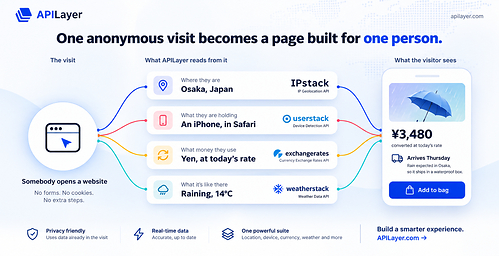
APILayer built four APIs that turn those two things into information a business can use. Each one hands its answer to the next.
It starts with the address. IPstack turns an internet protocol address into a geolocation: the country, the region, the city, along with the latitude and longitude, the local time zone, and the local currency, alongside more than 100 other details, including whether the visit is arriving through a VPN or a known proxy.
Two of those answers are useful straight away. Two of them lead somewhere else.
The currency is the first. Knowing that somebody pays in yen is not the same as knowing what a product costs in yen. Exchangeratesapi supplies the missing number, covering more than 170 world currencies from over 15 sources, with records reaching back to 1999. A country becomes a price in the money the visitor actually spends, at the rate that applies today.
The position on the map is the second. Weatherstack takes that position and returns the weather there, right now, later today, or on any day in the past, for millions of places worldwide, on land and at sea. Weather was never part of the visit. It comes from something that was.
The device is a separate question with a separate answer. Userstack identifies the browser, the operating system, and whether the visitor is on a phone, a tablet or a desktop computer. It also flags when a visit comes from a bot rather than a person, which keeps automated traffic out of the numbers a marketing team reports on.
None of this asks the visitor to do anything. No cookie. No pop-up requesting permission. No form to fill in. The information was already part of the visit, and the website's own server does the asking.
That matters more than it once did. Browsers have spent the past few years shutting down the tracking methods many websites leaned on. The information described here was never part of that system, so there was nothing in it to switch off.
What has changed is access. Instead of building and maintaining each capability separately, companies can now use one unified suite of APIs for location, device, currency, weather, and more. IPstack already supports MCP, with more MCP integrations coming soon.
The result is the difference between two websites that received exactly the same visit. One shows a price in the local currency, on a page built for the phone in the visitor's hand, with a delivery estimate that takes the local weather into account. The other shows everybody the same page, then waits for somebody to fill in a form before it learns anything at all.
All four are available now on the APILayer Suite, each with a free plan.
About APILayer
APILayer runs a suite of APIs covering location, device detection, currency exchange rates, weather and related services. Companies use them to add outside information to their websites and applications without building and maintaining the systems behind it.
Media Contact
Emiliano Trozzi, APILayer, 1 512-226-8080, [email protected], https://apilayer.com/
SOURCE APILayer


Share this article