
New Flashpoint Ignite capability helps intelligence teams operationalize General Intelligence Requirements and Priority Intelligence Requirements by connecting business priorities, monitoring activity, investigations, and measurable operational outcomes within a single workflow.
WASHINGTON, May 29, 2026 /PRNewswire-PRWeb/ -- Flashpoint, the global leader in threat intelligence, today announced the launch of Intelligence Requirements (IRs) in Flashpoint Ignite, a dedicated Intelligence Requirements workflow layer that allows organizations to define, manage, and operationalize both General Intelligence Requirements (GIRs) and Priority Intelligence Requirements (PIRs).
As cyber threat intelligence (CTI) programs mature, organizations increasingly face a new challenge: turning intelligence into meaningful action. While most security and risk teams recognize the value of CTI, many still struggle to consistently connect intelligence activity to business priorities, executive decision-making, and measurable outcomes.
For many organizations, PIRs have become the preferred framework to align intelligence with organizational priorities, but translating those priorities into structured workflows remains a persistent challenge. Requirements are often managed manually, while monitoring, investigations, and reporting operate across disconnected processes.
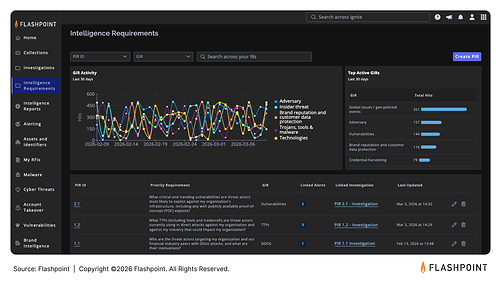
Flashpoint Intelligence Requirements help bridge that gap by bringing intelligence priorities, monitoring workflows, investigations, and reporting into a more unified operational model inside Ignite. By integrating operational priorities, incoming signals, investigative activity, and measurable outcomes into a single workflow, organizations can build intelligence programs that more effectively support executive decision-making, mission priorities, and enterprise risk management.
With Intelligence Requirements, organizations can:
- Centralize and structure Priority Intelligence Requirements (PIRs) directly within Ignite to create clearer alignment across intelligence operations.
- Connect alerts and monitoring activity to business priorities and organizational risk to improve focus and prioritization.
- Tie intelligence findings directly to Investigations workflows to support faster triage, collaboration, and response.
- Accelerate adoption with pre-built PIR templates or create custom intelligence requirements tailored to organizational priorities.
- Gain measurable visibility into intelligence activity, investigative trends, and how CTI supports operational and business outcomes.
In practice, this creates:
- Strategic Guardrails: Every alert that fires and every investigation that escalates can now be tied back to an operational priority or business risk. If activity does not map to a PIR, it becomes easier to identify where teams may be spending time on low-priority noise.
- Stakeholder Clarity: As intelligence teams support more internal stakeholders — including executive leadership, fraud teams, vulnerability management, or brand protection teams — Intelligence Requirements creates a clearer framework for communicating what is being monitored and why.
- Defensible ROI: By connecting priorities, alerts, and investigations into a measurable workflow, organizations gain stronger visibility into how intelligence operations support broader business and security objectives.
"The most effective threat intelligence programs are the ones aligned directly to the priorities that matter most to an organization — from reducing operational risk to enhancing executive and mission-level decision-making," said Josh Lefkowitz, Co-Founder and CEO of Flashpoint. "With Intelligence Requirements, Flashpoint is helping organizations with the critical effort to define and operationalize those priorities across intelligence workflows — creating a clearer connection between threat intelligence programs and outcomes."
How Flashpoint Intelligence Requirements Works
Intelligence Requirements introduces a structured workflow layer across Ignite.
Rather than beginning with disconnected alerts or investigations, organizations can now start with the intelligence questions they are trying to answer — and operationalize workflows from there.
Step 1: Define Intelligence Priorities
Teams begin by creating and organizing both General Intelligence Requirements (GIRs) and Priority Intelligence Requirements (PIRs). GIRs serve as broader intelligence focus areas, while PIRs represent the specific intelligence questions driving operational activity.
Customers can either build custom PIRs from scratch or use pre-built templates to accelerate onboarding and reduce the "blank page" challenge many organizations face when formalizing intelligence workflows.
2. Align Monitoring Workflows to PIRs
Once PIRs are established, analysts can map relevant alert rules directly to those intelligence priorities.
This is a foundational part of the workflow. PIRs are designed to give structure and context to intelligence activity by helping organizations clearly understand what is being monitored, why it matters, and which operational objective the activity supports.
To simplify setup, Ignite can surface:
- Existing alert rules already created within the platform,
- As well as AI-recommended alert rules based on the selected PIR and the organization's existing alert rule library.
This allows organizations to operationalize PIR workflows faster while reducing disconnected or ad hoc monitoring efforts.
3. Connect Monitoring to Investigations
As monitoring workflows surface meaningful activity, analysts can escalate findings directly into Investigations workflows within Ignite.
Organizations can optionally connect PIRs to new or existing investigations, helping maintain a clearer operational chain between:
- intelligence priorities
- incoming signal
- investigative activity
- and operational outcomes
Analysts can filter alerts by PIR directly in the inbox and escalate relevant findings for investigation.
4. Measure Intelligence Activity
Intelligence Requirements also introduces a more measurable operational framework for intelligence teams by providing visibility into monitoring activity, investigative escalations, and operational workflows tied to specific intelligence priorities.
Over time, this helps organizations better understand which priorities generate activity, where teams spend investigative effort, and how intelligence operations support broader business and security objectives.
Learn more about Flashpoint Intelligence Requirements and request a demo.
Frequently Asked Questions (FAQ)
What are the intelligence requirements in cyber threat intelligence?
Intelligence Requirements are the operational questions and priorities that guide intelligence collection, monitoring, investigations, and reporting activities.
Within CTI programs, organizations often structure these priorities through:
- General Intelligence Requirements (GIRs), which represent broader focus areas
- Priority Intelligence Requirements (PIRs), which represent the specific intelligence questions driving operational activity
Flashpoint Ignite operationalizes these requirements directly within monitoring and investigations workflows.
What is the difference between a GIR and a PIR?
GIRs represent broader intelligence focus areas, such as ransomware activity, credential exposure, or vulnerability risk.
PIRs are the specific intelligence questions organizations are trying to answer within those broader categories.
For example:
GIR: Ransomware
PIR: "Are ransomware groups actively targeting organizations in our industry?"
In Ignite, PIRs become operational by connecting directly to monitoring activity, alerts, and investigations.
How do PIRs work in Flashpoint Ignite?
In Ignite, organizations can create and manage PIRs directly within the platform, align alerts and monitoring activity to those PIRs, and connect investigative activity back to operational priorities.
This creates a more structured operational model in which intelligence activity is directly tied to business risk and organizational priorities.
Are Intelligence Requirements only for mature CTI programs?
No. While mature intelligence teams often already use PIR methodologies, Intelligence Requirements can also help newer or growing CTI programs establish more structured operational processes earlier in their maturity journey.
Pre-built PIR templates within Ignite help reduce the barrier to adoption and accelerate operationalization.
How do Intelligence Requirements improve intelligence operations?
Intelligence Requirements help organizations:
- prioritize monitoring activity,
- reduce disconnected workflows,
- organize investigations around operational priorities,
- and create clearer visibility into intelligence operations over time.
This allows teams to move from reactive intelligence activity toward a more intentional and measurable operational model.
Do Intelligence Requirements replace existing alerts or investigations?
No. Intelligence Requirements are designed to connect and structure existing operational activity, not replace it.
Organizations can align existing alerts and investigations with PIRs to create clearer operational context and visibility across intelligence workflows.
Can PIRs be aligned to multiple types of intelligence activity?
Yes. PIRs can support a wide range of intelligence operations, including:
- threat actor monitoring,
- credential exposure monitoring,
- vulnerability tracking,
- fraud investigations,
- operational intelligence reporting,
- and broader CTI workflows.
How does Flashpoint operationalize PIRs differently?
Many organizations still manage Intelligence Requirements through static documents, spreadsheets, or disconnected operational processes.
Flashpoint Ignite operationalizes PIRs directly within monitoring, investigations, and operational workflows, helping organizations connect priorities, incoming signals, investigative activity, and measurable operational outcomes inside the same system.
About Flashpoint
Flashpoint is the leader and largest private provider of threat data and intelligence. We empower mission-critical businesses and governments worldwide to decisively confront complex security challenges, reduce risk, and improve operational resilience amid fast-evolving threats. Powered by Flashpoint Primary Source Collection, our proprietary approach to collecting intelligence directly from the digital spaces where threats originate, the Flashpoint Ignite platform delivers unmatched depth, speed, and relevance from open and hard-to-reach sources, enriched by human expertise and scaled by AI. Our solutions span cyber threat intelligence, vulnerability intelligence, geopolitical risk, physical security, fraud, and brand protection. The result: our customers safeguard critical assets, avoid financial loss, and protect lives. Discover more at flashpoint.io.
Join the conversation. Follow us on LinkedIn and X.
Media Contact
Kari Walker, RedIron PR for Flashpoint, 1 7039288886, [email protected]
SOURCE Flashpoint

Share this article