Could the camera already in a patient's pocket help identify atrial fibrillation earlier? The condition is often silent, and for many patients the first sign is a stroke. A new U.S. clinical study is evaluating whether software using only a smartphone's built-in camera can detect atrial fibrillation. The first patient was enrolled at St. Bernards in Jonesboro, Arkansas, and the data are intended to support a future FDA 510(k) submission for Happitech's investigational Heart Rhythm Software.
ROTTERDAM, Netherlands, Nov. 17, 2026 /PRNewswire-PRWeb/ -- Happitech BV, a medical technology company specializing in smartphone-based photoplethysmography (PPG) for heart rhythm monitoring, today announced that enrollment is underway in a U.S. clinical study evaluating the performance of its investigational Heart Rhythm Software algorithm in detecting atrial fibrillation (AF). The study is a prospective, nonrandomized, observational, multicenter clinical investigation conducted under institutional review board oversight at each participating site.
- The study's first patient was enrolled at the Arrhythmia Research Group at St. Bernards in Jonesboro, Arkansas, under principal investigator Dr. Devi Nair.
- The prospective, multicenter study is enrolling patients across four sites in the United States and one in the Netherlands.
- Data generated by the study are intended to support a future FDA 510(k) submission for Happitech's investigational Heart Rhythm Software.
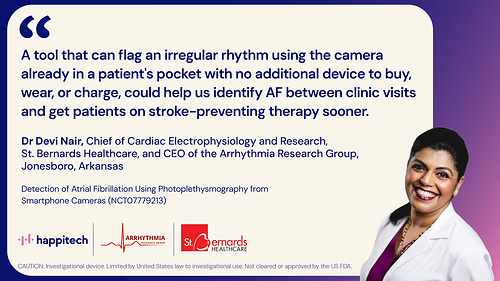
"Atrial fibrillation is often silent, and too many of the patients we see in northeast Arkansas first learn they have it after a stroke. Many of them live an hour or more from the nearest cardiologist, but nearly all of them carry a smartphone. A tool that could flag an irregular heart rhythm using the camera already in a patient's pocket with no additional device to buy, wear or charge, could help us identify AF between clinic visits and get patients on stroke-preventing therapy sooner. Enrolling the first patient in this study is a meaningful step toward generating the rigorous evidence needed to establish whether this approach can reliably serve that need, and we are proud that the work is beginning here in a community setting," said Dr. Devi Nair, Chief of Cardiac Electrophysiology and Research, St. Bernards Healthcare, and CEO of the Arrhythmia Research Group, Jonesboro, Arkansas.
An unmet need in heart rhythm monitoring
Atrial fibrillation is the most common sustained cardiac arrhythmia, and its global prevalence continues to rise. The condition is associated with an approximately fivefold increased risk of ischemic stroke and is a factor in around one in seven strokes overall, according to the U.S. Centers for Disease Control and Prevention [1]. Identifying episodes of AF can support physicians in clinical management decisions, including anticoagulation, rhythm control and risk factor modification.
Making it easier for patients to monitor their own heart rhythm could support identification of AF between clinic visits. An estimated 84% of U.S. adults ages 50 and older own a smartphone [2]. Happitech's Heart Rhythm Software is designed to analyze pulse rate data captured through a smartphone's camera to identify signals consistent with AF or normal sinus rhythm, running on a patient's own device without requiring a separate wearable or monitoring device. This approach is intended to make heart rhythm monitoring more accessible to patients who already carry a smartphone in their daily lives. The software is investigational in the United States and is not intended to diagnose or treat AF; any measurement suggestive of an irregular heart rhythm requires confirmation and diagnosis by a physician. Participation involves an additional, non-invasive PPG recording taken alongside each patient's standard-of-care 12-lead ECG; the study does not alter any patient's clinical care or treatment pathway.
"Enrolling the first patient in this U.S. study is an important step in generating the rigorous evidence needed to support a future FDA submission for Heart Rhythm Software. We're encouraged to be working alongside the leading researchers in the field as we build the evidence base this technology will need to earn patients' and physicians' trust," said Yosef Safi Harb, Founder and CEO of Happitech.
About Happitech
Happitech is a medical technology company specializing in AI-powered, smartphone-based photoplethysmography (PPG) for heart rhythm monitoring. In Europe, Happitech's technology is CE-marked as a Class IIa medical device under the EU Medical Device Regulation (MDR) and is used for early detection and ongoing management of atrial fibrillation. The technology is integrated into a number of remote patient monitoring platforms used by hospitals and healthcare providers across Europe. In the United States, the Heart Rhythm Software is investigational and has not been cleared or approved by the FDA; it is not available for commercial use in this jurisdiction.
Forward-looking statements
This press release may contain forward-looking statements relating to Happitech's investigational Heart Rhythm Software and the study described above, including statements regarding enrollment timelines and regulatory submissions. These statements are based on current expectations and are subject to risks and uncertainties, including those inherent to clinical research and regulatory review, that could cause actual outcomes to differ materially. Happitech does not undertake any obligation to update these statements as a result of new information or future events.
References: 1. About Atrial Fibrillation. 14 May 2024. US Centers for Disease Control and Prevention. https://www.cdc.gov/heart-disease/about/atrial-fibrillation.html. 2. Mobile Fact Sheet. 20 November 2025. Pew Research Center. https://www.pewresearch.org/internet/fact-sheet/mobile/.
Media Contact
Sohini Gowan, Happitech BV, 31 681885565, [email protected], https://happitech.com/
Yosef Safi Harb, Happitech BV, [email protected], https://happitech.com/
SOURCE Happitech BV

Share this article