
One of South of Broads Most Historically and Architecturally Distinguished Residences is Now Available for Purchase
CHARLESTON, S.C., May 6, 2026 /PRNewswire-PRWeb/ -- The Cassina Group is proud to announce that 21 East Battery Street is now available for sale, exclusively listed by Robertson Allen, Founding Partner and Broker-in-Charge. Known as the Edmondston–Alston House, this South of Broad property has stood overlooking Charleston Harbor for two centuries and stands as one of the city's most historically significant properties.
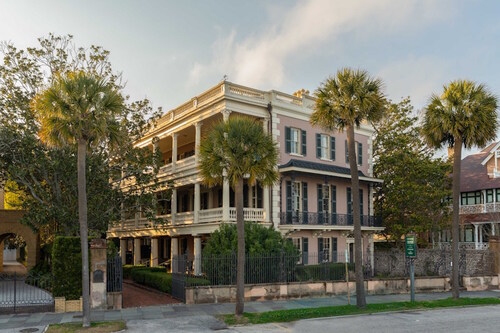
Originally constructed in 1825 for Scottish shipping merchant Charles Edmondston, the residence was among the first substantial houses built along the city's seawall and what is now Charleston's iconic High Battery. A decade later, the property was acquired by Charles Alston, a member of a well-established Lowcountry rice planting family, who refined the house in the Greek Revival style. Alston added architectural elements including the signature three tiered piazzas supported by Corinthian columns and a distinctive parapet bearing the Alston family crest.
From its earliest years, the house has been closely tied to Charleston's network of prominent families. In 1849, the marriage of Williams Middleton to Susan Pringle Smith united the Edmondston–Alston House with Middleton Place under one extended family lineage. Susan Pringle Smith's ancestry traces to Bishop Robert Smith, who arrived in Charleston in 1757, and served as the first American Episcopal bishop of the Diocese of South Carolina. Bishop Smith also played a foundational role in the creation of the College of Charleston, helping to finance and establish the institution. Through generations of intermarriage among the Smith, Middleton, and Alston families, ownership and stewardship of both Middleton Place and the Edmondston–Alston House became intertwined, reinforcing a legacy deeply rooted in land and heritage.
"21 East Battery Street stands as a remarkable expression of Charleston's history, offering the opportunity to become part of a story that has unfolded over generations," said Robertson Allen of The Cassina Group. "The opportunity to steward a property of this significance along the Charleston Battery is exceptionally limited."
The house has witnessed defining moments in American history. From the third floor piazza overlooking the harbor, Confederate General P. G. T. Beauregard observed the first shots of the Civil War in 1861. Later that year, General Robert E. Lee sought refuge here during the Great Fire of Charleston.
For generations, the Edmondston–Alston House functioned not only as a residence but as part of a broader narrative connecting Charleston to Middleton Place. The Edmondston–Alston House served as a seasonal house, with family members residing during the summer months while maintaining their deep ties to the Middleton Place property. The grounds of the Edmondston–Alston House, surrounded by large oak trees, provided shade during the summer months. Within the house, the interiors were filled with historical artifacts and heirlooms, including Middleton Place silver. Over time, as family needs evolved, portions of the house were preserved while others remained actively lived in, reflecting the natural progression of a house continuously shaped by its stewards.
In 1969, a generational transition took place when ownership of the Edmondston–Alston House formally passed to Charles Halliwell Pringle Duell, a twelfth generation Middleton descendant. The estate was thoughtfully divided, with Charles receiving the physical properties, including the Edmondston–Alston House and Middleton Place.
The property features three distinct structures, creating a private enclave rarely found within Charleston's historic district. The main residence welcomes guests through a foyer that immediately establishes the scale of the house. Twelve foot ceilings, original moldings, and period craftsmanship reflect the artistry of early nineteenth century construction. Architectural detailing evolves from floor to floor, with subtle variations in trim work that speak to the layered history of the house.
On the main level, two formal parlors extend from the central foyer, with original pocket doors allowing the spaces to flow together for entertaining or remain intimate for quieter gatherings. A staircase rises to the second floor, where two additional parlors continue the tradition of formal entertaining. These grand rooms, with their twelve foot ceilings, fireplaces, and intricate millwork, once served as important social spaces within the household. One parlor was historically reserved for ladies' gatherings, offering a glimpse into the customs of the period, while a library, traditionally used as a gentlemen's withdrawing room, adds further character to this level.
The third floor serves today as the primary living quarters, where natural light and harbor views reflect the house's original design and orientation toward Charleston Harbor. This level includes two bedrooms, along with a spacious dining room that could easily serve as an additional bedroom.
Directly behind the main residence, The Quarters, historically the kitchen building and living quarters for the enslaved, have been preserved and now serve as a private two story retreat with a living area, kitchenette, and gas burning fireplace on the main level. Upstairs, well proportioned bedrooms and bathrooms make for inviting accommodations.
Adjacent to the Quarters is the historic Carriage House, originally used as stables for horses and carriages as well as quarters for groomsmen, now configured as a bed and breakfast. The interiors retain original beamed ceilings and heart pine floors, preserving the authenticity of the structure. A sitting room occupies the main level, while one generously sized gathering room and bedroom are located upstairs. Together, the main residence, The Quarters, and The Carriage House form an exceptional historic estate along Charleston's High Battery. With harbor views, architectural pedigree, and centuries of documented history shaped by generations of stewardship, 21 East Battery Street offers a rare opportunity to own and preserve a remarkable piece of Charleston's past.
Media outlets and editorial partners interested in previewing the home or arranging exclusive feature coverage are encouraged to contact Robertson Allen, Listing Agent, directly or Angela Tice, Marketing Director.
Robertson Allen is the leading force in the region's luxury real estate market. As a top Charleston real estate agent with over 20 years of experience and more than $1 billion in career sales, Allen has closed more $10 million plus transactions than any other agent and is recognized by RealTrends Verified 2025 as the #1 agent in South Carolina and by Charleston MLS as the #1 agent in Charleston County in 2025. His continued success is built on persistence, expertise, and a genuine passion for serving his clients.
Allen's portfolio contains many significant transactions including 51 East Bay Street at over $21 Million, 5 East Battery at $18.25 Million, 202 Bank Street at $14 Million, 13 & 15 Meeting Street at $12.6 Million, 13 & 15 East Battery for $12.45 Million, 2411 Atlantic Avenue for $10.1 Million, and 172 Tradd Street at $10 Million. His clientele ranges from long-time local families to national, and international, executives drawn to Charleston's timeless architecture, coastal beauty, and lifestyle. His deep knowledge of Charleston's most sought after neighborhoods, paired with his thoughtful and "client first" approach, continues to position him as a leader in the residential luxury market.
To reach Robertson Allen, contact 843.442.6534 or visit RobertsonAllen.com. The Cassina Group is the leading luxury real estate brokerage with offices in Charleston, SC and Mount Pleasant, SC. The firm is managed by founding partners and Brokers-In-Charge, Jimmy Dye and Robertson Allen. For media inquiries, contact The Cassina Group at 843.628.0008 or visit TheCassinaGroup.com.
Media Contact
Simon Ashton, SIMS Agency, 1 8433219292, [email protected]
SOURCE The Cassina Group

Share this article