
Free September 2 webinar and educational resource package will explain how some beneficiaries who do not receive SSI or SSDI may still qualify as Eligible Designated Beneficiaries and preserve the lifetime stretch for inherited retirement accounts under the SECURE Act.
PITTSBURGH, Aug. 28, 2026 /PRNewswire-PRWeb/ -- Families with children or grandchildren who do not qualify for SSI or SSDI may be overlooking a little-known provision of federal tax law that could dramatically improve the tax treatment of an inherited IRA. For beneficiaries who qualify as Eligible Designated Beneficiaries, the ability to stretch inherited IRA distributions over a lifetime can produce enormous tax savings. In one family case study featured in the program, planning involving a $500,000 inherited IRA is projected to leave the beneficiary approximately $1.178 million better off over her lifetime, measured in today's dollars.
Under the "chronically ill" exception in IRC §7702B(c)(2), some beneficiaries can qualify as Eligible Designated Beneficiaries, or EDBs, without obtaining a disability determination from the Social Security Administration. EDB status can preserve life-expectancy distributions from an inherited retirement account instead of subjecting the account to the SECURE Act's general ten-year distribution rule, which can substantially reduce the total tax paid on those funds.
On Wednesday, September 2, James Lange, CPA/Attorney, father of a child with a disability, and Andrew H. Hook, CELA, AEP, CFP®, former president of the Special Needs Alliance, will explain this underused planning opportunity during a free live webinar for parents and grandparents.
The program will also give attendees a substantial package of educational resources designed to help families and their advisors understand both the opportunity and the steps required to pursue it. Among them are two recent Forbes.com articles by Lange devoted specifically to the chronically ill EDB pathway: How to Provide for Children Who Fall Between Disabled and Independent and Beyond SSI/SSDI: How to Get the "Chronically Ill" Lifetime IRA Stretch.
The first explains how some beneficiaries who fall between qualifying as disabled and being fully independent may nevertheless qualify under a separate "chronically ill" provision of tax law. The second focuses on the practical mechanics of qualification, certification, documentation, and implementation.
Attendees will also receive Hook's Chronically Ill EDB Planning Guide & Certification Template Package, a detailed resource developed by Hook that brings together the legal framework, planning considerations, certification process, implementation guidance, and model documents needed to address the chronically ill EDB rules in practice.
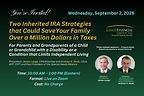
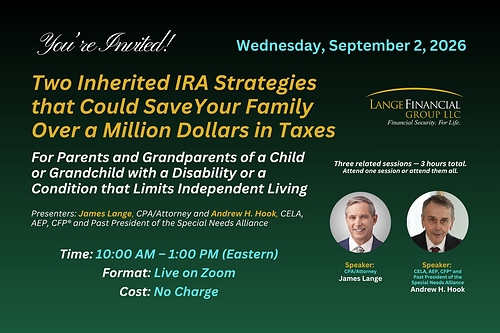
Two Inherited IRA Strategies That Could Save Your Family Over a Million Dollars in Taxes will be presented live on Zoom from 10:00 a.m. to 1:00 p.m. Eastern on September 2.
Registration is free at: https://DisabledChildPlanning.com/Parents
Hook, whose firm has successfully navigated the chronically ill EDB certification process for clients, says the primary obstacle to greater use of the pathway is simply lack of awareness.
"The chronically ill pathway is real, it is workable, and it is underutilized," Hook said.
The pathway does not require an SSI or SSDI determination and imposes no Social Security earnings test. Certification does not have to come from a physician. It may be provided by a licensed health care practitioner, including a physician, registered professional nurse, or licensed social worker. A beneficiary may work, earn income, or function independently in some areas of life and still qualify if the statutory requirements are met.
In Hook's practice, the most common qualifying path has been the severe cognitive impairment and substantial supervision test, with beneficiaries including individuals with autism spectrum disorder, traumatic brain injury, intellectual disability, and early-onset dementia.
Lange has illustrated the potential magnitude using his own family's planning. After Lange's father-in-law died, advance beneficiary and disclaimer planning allowed his wife to disclaim a $500,000 share of the inherited IRA, which passed to a Special Needs Trust for their daughter, Erica, who qualifies as a disabled EDB. Lange projects that the strategy will leave Erica approximately $1.178 million better off over her lifetime, measured in today's dollars.
"What few families realize is that this opportunity is not limited to beneficiaries who qualify through SSI or SSDI," Lange said. "For families who have assumed the ten-year rule was unavoidable, the chronically ill exception could completely change the planning conversation."
The September 2 program includes a full session by Hook on who may qualify and how the certification process works, Lange's session on the disclaim-to-Special-Needs-Trust strategy, a live question-and-answer session, and a closing session on Roth IRA conversions. Because beneficiary designations, trust provisions, and documentation must often be coordinated in advance, understanding the strategy before an IRA owner dies can be critical.
The webinar is intended for parents and grandparents of a child or grandchild with a disability or a condition that limits independent living. Attendees may participate in one session or the entire three-hour program.
In addition to the two chronically ill Forbes.com articles and Hook's planning guide and templates, attendees will receive a digital reprint of Lange's Forbes.com article on the Disclaim-to-Special-Needs-Trust strategy. A complimentary hardcover copy of Retire Secure for Parents of a Child with a Disability will also be available while supplies last.
Webinar Details
Two Inherited IRA Strategies That Could Save Your Family Over a Million Dollars in Taxes
Wednesday, September 2, 2026
10:00 a.m. – 1:00 p.m. Eastern
Live on Zoom | No Charge
Registration: https://DisabledChildPlanning.com/Parents
About James Lange
James Lange, CPA/Attorney, is the author of ten best-selling financial books including Retire Secure for Parents of a Child with a Disability. He is a Forbes.com contributor and has been quoted 37 times in The Wall Street Journal. His work focuses on retirement-account tax planning, Roth IRA conversions, and financial planning for families with a child who has a disability.
About Andrew H. Hook
Andrew H. Hook, CELA, AEP, CFP®, is a former president of the Special Needs Alliance, a Fellow of ACTEC and NAELA, former editor-in-chief of the NAELA Journal, and co-author of the Special Needs Trust Handbook. He is Of Counsel to Hook Law Center in Virginia Beach, Virginia, with more than 50 years of legal experience.
Media Contact
Erika Hubbard, Lange Financial Group, LLC, 1 4125212732 224, [email protected], https://disabledchildplanning.com
SOURCE Lange Financial Group, LLC

Share this article