
Researchers across RIT's campus are utilizing quantum in a variety of disciplines to continue to push the boundaries in science, engineering, and technology.
ROCHESTER, N.Y., Jan. 22, 2026 /PRNewswire-PRWeb/ -- In 1925, German physicist Werner Heisenberg published a paper on quantum mechanics, upending classical physics and launching the world into the quantum age.
Now, 100 years later, researchers across RIT's campus are utilizing quantum in a variety of disciplines to continue to push the boundaries in science, engineering, and technology.
While classic physics explains the behavior of objects in everyday life, quantum mechanics examines how atoms and light interact on the nanoscale. Studying matter in its smallest form is complex, which is why understanding quantum has only really begun in the past century.
RIT researchers are zeroing in on quantum photonics, the creation, control, and detection of light. Photonics has long been a specialty of the university. RIT led the team that developed the first quantum photonic wafer, which is key to the future of mass-produced quantum communication systems.
"Using photons the way that we formerly used electrons is going to make everything smaller, cheaper, faster, better," said Ryne Raffaelle, vice president for Research.
Researchers are also putting quantum theory into action with the goal of building quantum computing systems. At the same time, experts must prepare for cybersecurity threats in the quantum era.
"Quantum has been worked on and theorized for a long time, and we are at the point where it is manifesting," Raffaelle said.
In other words, RIT researchers are taking theory imagined in old science fiction movies and engineering it into reality. Keep reading to see how.
Rochester's optics legacy powers the quantum future
Computers have always been an interest of Stefan Preble '02 (electrical engineering), professor in the Department of Electrical and Microelectronic Engineering.
In the early internet days, Preble was tying up his parents' phone line so much they got him his own dedicated line. Fast forward, and now Preble is working to change the world of internet communication with an experimental quantum network.
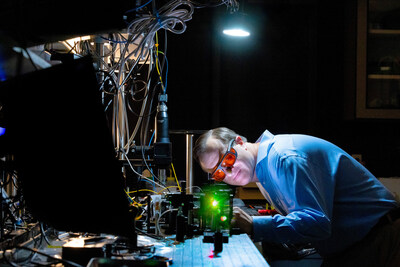
Through a partnership with the University of Rochester, the Rochester Quantum Network (RoQNET) is an 11-mile network that uses single photons to transmit information between the two campuses along fiber optic lines. While quantum communication networks exist around the country and the world, this is the first centered on quantum photonic chips.
Quantum communication networks have the ability to change the way information is sent and received because they provide a more secure network where messages cannot be cloned or intercepted without detection.
Quantum bits, or qubits, make these networks possible. Qubits can be created in numerous ways, but photons (individual particles of light) are proving to be the best type of qubits for communication networks because they can be transmitted over already existing fiber optic lines.
With its legendary history in optics, the Rochester region was the ideal place to make a photonics-based quantum network a reality.
"Rochester has always been a significant contributor to optics, so who else is going to do it?" said Preble. "It's on us to establish this and hopefully it will be a legacy down the line when we have these quantum technologies."
The region's expertise in microchip technology has also positioned RIT to be a leader in quantum communication. Sophisticated microchips are needed to process the photonic quantum states.
In 2020, Preble and a team of RIT's Future Photon Initiative researchers collaborated with the Air Force Research Laboratory to produce the Department of Defense's first-ever fully integrated quantum photonic wafer.
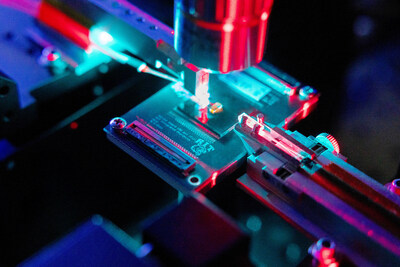
Wafers are used to mass produce integrated circuits or microchips and help with research in quantum photonics. The wafers allow for experiments that need a large, optical table to be scaled down to a tiny microchip, making it possible to explore bigger, more complex systems, specifically in quantum computing.
Preble's expertise in integrated photonics dates back to his days as an undergraduate student, where he first became interested in quantum. After completing his bachelor's degree at RIT, Preble attended Cornell University to receive his Ph.D. in electrical and computer engineering, where he was introduced to the new field of silicon photonics.
While light circuitry on a microchip had been investigated previously, it wasn't being done on silicon at the time. Nanostructures made with silicon were well developed for the electronics industry, so being able to adapt the same material for photonics allowed it to scale up commercially very rapidly.
Once Preble started job searching, a position at RIT in silicon photonics came to his attention. He applied, was hired, and now he is pushing the world of quantum silicon photonics forward.
"I was compelled by the silicon photonics research of my Ph.D. adviser, and I was attracted to the fact that I could combine my ongoing interest in quantum with the newly emerging field of photonic microchips," said Preble. "Microchips are able to address the challenges of scaling quantum photonic systems."
As the graduate program director of the microsystems engineering Ph.D. program, Preble guides the next generation that will keep moving quantum technology forward.
One such student, Vijay Sundaram '21 MS (physics), was the lead author for a RoQNET paper that was published in Optica Quantum. Like many kids, Sundaram wanted to be an astronaut when he got older, so he went into aerospace engineering in his home nation of India, but he shifted to physics for his master's degree at RIT.
During that graduate program, he discovered that astrophysics is math intensive, with a lot of work in computer simulation. Sundaram was more interested in experimental science and being in a lab. A quantum optics course steered him in the direction of microsystems engineering, where he is now on the forefront of a budding new field.
Sundaram recognizes that the first fully working quantum computer could be decades away, but his work now and in his future career makes it a possibility. Private companies like IBM and Google, and public entities like the Air Force, are already working toward a quantum future. There is a wide range of career opportunities for Sundaram in quantum technology.
"There's quantum for finance, for security, for communication," Sundaram explained. "You can apply this to pretty much everything. The applications are endless."
Just as it was fortuitous that Preble entered a Ph.D. program as a new field was growing, now Sundaram and Preble's other advisees can get involved in quantum as it begins to shape the world.
"Each one of my students has gone on to great success," said Preble. "They are at top research institutions in the world and leading global research. Working with students is the most rewarding aspect of this job."
Researchers map quantum education efforts nationwide
As quantum continues to evolve from theory to application, an educated workforce is needed to scale up manufacturing and to adopt these tools in a range of industries, including aerospace, pharma, finance, and biomedicine.
Backed by funding from the National Science Foundation and the Department of Defense, a research team led by Professor Ben Zwickl has mapped where quantum courses can be found at higher education institutions across the country. The team is also in the process of interviewing quantum industry professionals to gain a deeper understanding of the landscape and needs of the quantum workforce.
"In order to grow quantum technology, you need people that know how to make, design, and build that technology," said Zwickl. "There is a direct call to research the landscape of education opportunities in quantum science and quantum technology, to understand the jobs that are out there, and to bridge the gap between school and work."
After a year of research, Zwickl and his team have created a database of all quantum courses offered at nearly 1,500 higher education institutions. At the end of the study, their goal is to have a more comprehensive picture of the quantum information science and engineering (QISE) education landscape. With this clear picture, guidance can be given to make the path into QISE more transparent for students from all backgrounds.
Zwickl is also an adviser for an interdisciplinary minor in quantum information science and technology at RIT. Enrollment has grown every semester since it launched in fall 2022, he said.
The minor is highly interdisciplinary in nature, with faculty from the College of Science, Kate Gleason College of Engineering, College of Engineering Technology, College of Liberal Arts, and Golisano College of Computing and Information Sciences offering classes that count toward the minor.
Classes available in the minor include introductions to quantum computing and other quantum technologies, linear algebra (the mathematical language of quantum computing), optics and lasers, quantum optics, quantum-resistant cryptography, photonic integrated circuits, and course options on ethics and technology.
With these offerings and research knowledge, RIT finds itself well poised to help fill the future quantum workforce.
"We continue to develop the coursework in the minor with plans to grow it," added Zwickl. "Quantum is where things are changing, and there's a huge opportunity. It is becoming much more accessible for students from different majors, and we have courses at RIT that are part of that shift."
Media Contact
Mollie Radzinski, Rochester Institute of Technology, 585-520-1487, [email protected], www.rit.edu
SOURCE Rochester Institute of Technology


Share this article