
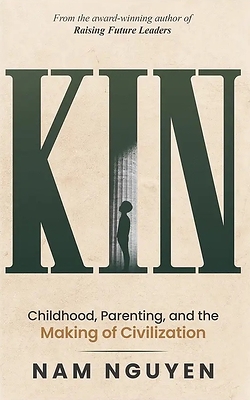
Across human history, societies have repeatedly reinvented childhood around their institutions, technologies, and expectations. In KIN: Childhood, Parenting, and the Making of Civilization, Nam Nguyen traces those transformations from humanity's earliest communities to the digital age—and asks what kind of childhood artificial intelligence may create next.
MONTREAL, Sept. 1, 2026 /PRNewswire-PRWeb/ -- Childhood has never been a fixed experience. From agricultural societies that depended on children's labor to industrial economies that moved them into schools and consumer societies that increasingly built markets around them, each era has reshaped childhood around its own institutions, technologies, and expectations. In his new book, KIN: Childhood, Parenting, and the Making of Civilization, released today, Canadian author Nam Nguyen examines those transformations across human history—and asks what childhood may become in the age of artificial intelligence.
Spanning humanity's earliest communities to the digital age, KIN explores how the ways societies raise children have changed alongside civilization itself. Children have been raised as helpers, heirs, believers, workers, students, citizens, consumers, and digital natives, reflecting what different societies needed, valued, and imagined for their futures.
"Childhood has never been fixed. Every era has remade it around its institutions, technologies, and expectations," Nguyen said. "The question now is what kind of childhood the age of artificial intelligence will create."
The book traces that evolution from shared caregiving in early human communities through agriculture, religion, empire, industrialization, compulsory schooling, consumer culture, screens, and artificial intelligence. Rather than presenting parenting as a private matter or offering parenting prescriptions, KIN places childhood within the larger story of how civilizations reproduce themselves—and how they change.
That historical perspective gives new context to current debates about children and AI. Artificial intelligence can already answer questions, assist with schoolwork, generate stories and images, recommend content, and increasingly shape how young people encounter information. Nguyen argues that the larger question is not simply whether children should use AI, but what happens when a new technology begins influencing the experience of childhood itself.
"History is usually told through wars, rulers, inventions, and institutions," Nguyen said. "But long before children become citizens, workers, leaders, or voters, they are being shaped by the world around them. Putting childhood back into the story changes how we see civilization."
Nguyen brings an interdisciplinary background spanning psychology, neuroscience, business strategy, and governance. Before moving into strategic advisory work, he conducted neuroscience research on visual attention and cognition at the Université de Montréal. His writing explores human development, institutions, technology, and the forces shaping future generations.
KIN has received recognition from independent editorial reviewers. Kirkus Reviews called it "a wide-ranging and thought-provoking study of childrearing throughout human history." BookLife Reviews, which named KIN an Editor's Pick, described it as "thoughtful and unapologetically grand" and said it offers "a compelling lens through which to view humanity's history and uncertain future." Foreword Clarion Reviews called its argument "compelling" and highlighted "a refreshing depth of original thinking."
KIN: Childhood, Parenting, and the Making of Civilization is available September 1 in print and digital editions.
Nguyen is available for interviews on the evolution of childhood, parenting across history, children and artificial intelligence, and the institutions shaping the next generation. Media materials, including author photographs, a high-resolution book cover, and additional information about KIN, are available upon request.
Media Contact
Nam Nguyen, Octomind Publishing, 1 5142187956, [email protected]
SOURCE Octomind Publishing



Share this article