
The Enterprise Threat Intelligence Report: 2027 will find threat intelligence budgets holding steady or growing, with leaders prioritizing demonstrable value, proof of concept, and predictable costs for agentic AI.
WASHINGTON, Oct. 13, 2026 /PRNewswire-PRWeb/ -- Flashpoint, the global leader in threat intelligence, today released The Enterprise Threat Intelligence Report: 2026. The independent research, commissioned by Flashpoint, examines the challenges shaping enterprise threat intelligence programs as AI-fueled attacks accelerate, where teams plan to expand coverage, and how they're approaching agentic AI as they plan for 2027.
The Enterprise Threat Intelligence Report: 2026 shows threat intelligence teams heading into 2027 under growing pressure as the AI threat landscape accelerates faster than their capacity to keep up. Many organizations (50%) are increasing threat intelligence investment in response, with AI-related threats emerging as the leading priority for expanded coverage and new investment. Yet despite the attention surrounding agentic AI, most teams (75%) are still evaluating where it can deliver meaningful value for defenders, balancing the potential to extend analyst capacity with expectations around intelligence quality, control, and human oversight.
"2027 will test whether threat intelligence programs can scale their reach as fast as AI is reshaping the threat landscape," said Josh Lefkowitz, Co-Founder and CEO of Flashpoint. "The opportunity for agentic AI on the defensive side is significant, and our research shows security leaders are ready to invest. But they aren't swayed by the hype. They're holding agentic AI to a high bar, and they want to know where it improves their work, whether they can trust the output, and where human judgment must remain part of the process."
Key findings include:
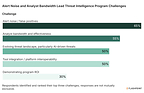
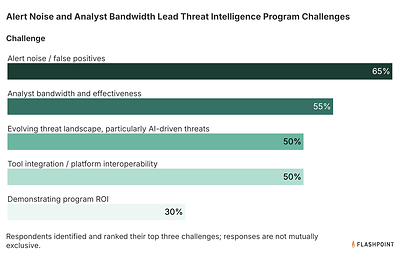
- AI is expanding the threat landscape and increasing operational pressure on intelligence teams. Alert noise and false positives were the top pain point, cited by 65% of respondents, followed by insufficient analyst bandwidth at 55% and product integration gaps at 50%.
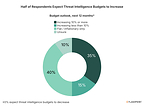
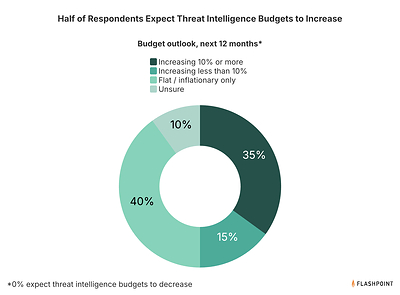
- Threat intelligence budgets are rising to close the gap. Half of respondents expect budgets to increase over the next 12 months, including 35% anticipating increases of 10% or more. Another 40% expect spending to remain essentially flat, and none anticipate a decrease. Growing budgets are supporting AI-related threat coverage, additional intelligence feeds and modules, and broader program development.
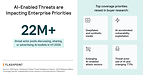
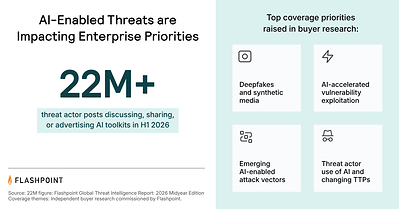
- AI-related threats are the leading priority for expanded coverage and new investment. Practitioners identified deepfake detection, AI-accelerated vulnerability exploitation, and emerging AI-enabled threat vectors as expanding intelligence requirements.
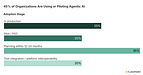
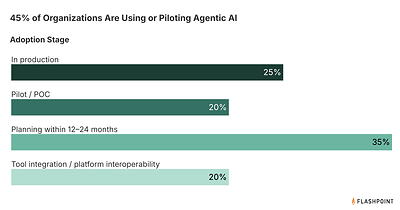
- Agentic AI adoption is underway, but teams are setting a high bar. Just 25% of organizations are using agentic AI in production today to power their threat intelligence teams, while 20% are piloting it and 35% plan adoption within 12 to 24 months. As adoption expands, so does scrutiny. Threat intelligence leaders are applying the same investment standards to agents as other technologies: 55% cited demonstrable time savings or the ability to extend analyst reach as an investment requirement, while 35% want real-world evidence through a proof of concept or pilot first. Their no-gos: lack of demonstrable value and unpredictable AI costs were among the most commonly cited barriers to investment.
With The Enterprise Threat Intelligence Report: 2026, security and threat intelligence leaders can discover:
- Which operational challenges are putting the greatest pressure on analyst capacity and threat intelligence programs today.
- How intelligence requirements are changing as AI-enabled threats create new coverage priorities.
- How threat intelligence budgets are trending in the next 12 months, and where incremental budgets will go.
- Where practitioners see the strongest applications for agentic AI, and which AI-powered workflows face a higher threshold for trust and autonomy.
- What teams need to prove before expanding AI investment, including the metrics practitioners are using to evaluate time savings, accuracy, risk reduction, and ROI.
To access The Enterprise Threat Intelligence Report: 2026, visit Flashpoint's website.
Join Flashpoint's Ian Gray, VP of Intelligence, and Joe Sawyer, Chief Market Officer, for a live webinar on October 14 to unpack the report and implications for 2027 planning. Register now.
Methodology
Flashpoint commissioned independent qualitative research among more than 20 threat intelligence budget owners and influencers at large North American enterprises. Respondents came from financial services and insurance, healthcare and biotech, retail, and information technology and telecommunications. Interviews took place in early fall 2026.
FREQUENTLY ASKED QUESTIONS (FAQ)
Q: What is Flashpoint's Enterprise Threat Intelligence Report: 2026?
The Enterprise Threat Intelligence Report: 2026 examines the challenges, priorities, budgets, and AI adoption plans shaping enterprise threat intelligence programs heading into 2027. The report combines independent qualitative buyer research commissioned by Flashpoint with Flashpoint threat intelligence to provide a view into how organizations are responding to changing intelligence requirements and evaluating the role of AI in their operations.
Q: What are the biggest challenges facing threat intelligence teams?
Alert noise and false positives were the most frequently cited challenge, identified by 65% of respondents. Analyst bandwidth and effectiveness followed at 55%, while 50% cited tool integration and interoperability. The findings show that many of the biggest pressures facing threat intelligence programs are operational, with teams looking for ways to make better use of existing analysts, intelligence, and systems.
Q: How are threat intelligence budgets changing heading into 2027?
Half of respondents expect their threat intelligence budgets to increase over the next 12 months, including 35% who anticipate increases of 10% or more. Another 40% expect budgets to remain essentially flat, 10% are unsure, and no respondents anticipate a decrease. Organizations expecting meaningful growth pointed to AI defense capabilities, expanded intelligence feeds and modules, and broader program development as investment priorities.
Q: How is AI changing threat intelligence requirements?
AI-related threats were the most frequently cited area where organizations want to expand intelligence coverage. Practitioners identified priorities including deepfakes and synthetic media, AI-accelerated vulnerability exploitation, emerging AI-enabled attack vectors, and changes in threat actor tactics, techniques, and procedures. Flashpoint separately tracked more than 22 million threat actor posts discussing, sharing, or advertising AI toolkits during the first half of 2026.
Q: How widely is agentic AI being used in threat intelligence today?
Twenty-five percent of organizations interviewed are using agentic AI in production today, while 20% are piloting it. Another 35% plan to adopt agentic AI within the next 12 to 24 months, while 20% remain cautious or in a wait-and-see posture. The findings indicate that organizations are interested in agentic AI but are taking a measured approach to where and how it is deployed.
Q: What are organizations looking for before giving AI greater autonomy?
Practitioners raised considerations including accuracy, trust, data leakage, auditability, regulatory requirements, cost, permissions, and human oversight. The research suggests that tasks with reviewable outputs, reversible actions, and clear success criteria can provide a practical starting point, with stronger controls becoming increasingly important as agents take on actions with greater operational consequences.
ABOUT FLASHPOINT
Flashpoint is the leader and largest private provider of threat data and intelligence. We empower mission-critical businesses and governments worldwide to decisively confront complex security challenges, reduce risk, and improve operational resilience amid fast-evolving threats. Powered by Flashpoint Primary Source Collection, our proprietary approach to collecting intelligence directly from the digital spaces where threats originate, the Flashpoint Ignite platform delivers unmatched depth, speed, and relevance from open and hard-to-reach sources, enriched by human expertise and scaled by AI. Our solutions span cyber threat intelligence, vulnerability intelligence, geopolitical risk, physical security, fraud, and brand protection. The result: our customers safeguard critical assets, avoid financial loss, and protect lives. Discover more at flashpoint.io.
Join the conversation. Follow us on LinkedIn.
Media Contact
Kari Walker, RedIron PR for Flashpoint, 1 7039288886, [email protected]
SOURCE Flashpoint

Share this article