Escrow, independent counsel and a site inspection — the protection Americans rely on at home — now travel with the buyer abroad. Early access opens today, starting with Ghana and Kenya.
CARLSBAD, Calif., Nov. 10, 2026 /PRNewswire-PRWeb/ -- Migrants sent a record $728.6 billion home to low- and middle-income countries in 2025, and more than $180 billion of it went to housing, savings and investment, according to the U.N.'s International Fund for Agricultural Development. Yet the protections an American gets on every domestic purchase — escrow, a title search, a lawyer who answers to the buyer — stop at the border. In many cases, buyers purchasing property abroad rely primarily on trust and good faith.
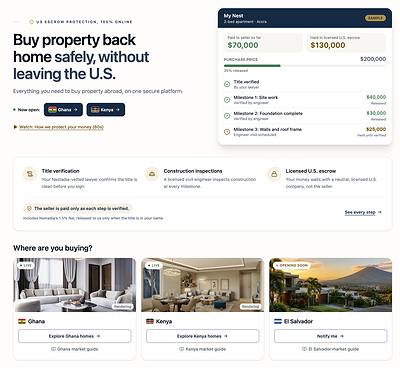
Nestadia launches today to bring institutional-level security to the U.S. diaspora for the first time. On Nestadia, verification comes first and money moves last. A buyer's funds are held by a U.S.-licensed escrow company and released to the seller only in stages, each certified by an independent law firm the buyer chooses, a licensed civil engineer who visits the site, and, for the final payment, the land registry itself. Nestadia runs the process and the proof; it is not a broker and does not hold or move the buyer's money.
"For many in the diaspora, buying property back home is about connection, security and pride — yet for too long the process has been defined by uncertainty," said Jana Bayad, founder and CEO of Nestadia. "As a global citizen, I know the feeling of wanting to invest abroad and the maze you have to navigate to do it. I built Nestadia to take the uncertainty out of it, so buyers can invest with full confidence."
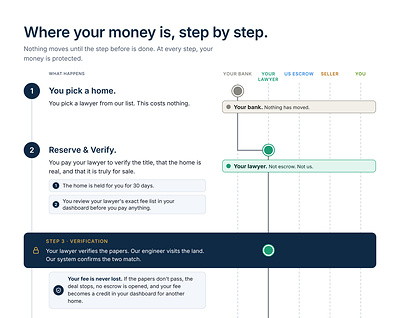
How it works: four steps, with the buyer in control at each
- Find. Buyers browse homes from vetted developers. Every listing shows exactly how much has been verified, from "Seller-stated" to "Verified." Buyers who find a property anywhere else, on social media or a developer's site, can submit the link at nestadia.com/verify-property for complimentary seller verification.
- Verify. A law firm the buyer chooses from Nestadia's panel, with its full fee list shown up front, searches the title; a licensed civil engineer visits the site and files location-tagged photos; Nestadia's system matches the two against the listing, field by field. If the property fails, the fee becomes a credit toward another home.
- Agree and fund. The buyer's own law firm drafts the purchase agreement on the verified title. The buyer signs online and sends one wire to a U.S. escrow account. Payment details appear only inside the buyer's dashboard, never by email or text, a common safeguard against wire fraud.
- Own. Escrow releases funds to the seller in stages, each against professional proof. The largest payment, half the price, is held until the property is registered in the buyer's name. If the purchase does not complete, the escrowed balance is returned to the buyer. A short video of the process is at nestadia.com/how-it-works.
Built to verify first, trust second
"Most property platforms were built to list homes and added trust later," said Eric Johannsen, Technology Advisor to Nestadia and former CTO of Dama Financial. "Nestadia's architecture starts from the opposite end: every line of code assumes someone will try to commit fraud. No single person, document, or click can move a buyer's money, independent professionals must agree before a property is verified, and a buyer's silence is never taken as consent. Designed to the highest security standards, we use AI to attack every release candidate ourselves, finding weak points before attackers do."
Partners and markets
U.S.-based buyers are already joining the waitlist. VAAL Real Estate, a leading developer in Africa, is Nestadia's first developer partner and is listing properties in both Ghana and Kenya, with additional developers being onboarded.
The platform is country-agnostic by design: each market plugs in its own panel of law firms, licensed engineers and registry rules, while the U.S. escrow rail and the buyer's dashboard stay the same. In the launch markets, Nestadia works with Alianz Escrow, a U.S.-licensed escrow company; AB & David Africa and Zoe, Akyea & Co. in Ghana; and Oraro & Company Advocates in Kenya. Buyers choose their own firm from the panel and pay it directly.
Nestadia's fee is 1.5% of the purchase price, held in escrow and paid only at closing. Early access is free for buyers living in the United States.
Nestadia is raising a $1 million pre-seed round under Rule 506(c); accredited investors can request details at nestadia.com/investors.
About Nestadia
Nestadia is the cross-border home-buying platform. A buyer in one country purchases property in another with a law firm of their choice, a licensed engineer on the ground and a U.S. escrow account, inside one dashboard, so that money moves only after the property is independently verified. Built first for the U.S. diaspora and designed to run in any country, Nestadia brings institutional-level protection to every purchase. Nestadia, Inc. is a Delaware corporation based in Carlsbad, California. Learn more at nestadia.com.
About the founder
Jana Bayad is a former executive at HP, Humana and Best Buy Health, where she led revenue and customer-experience organizations responsible for more than $100 million in digital revenue. She previously founded Singldout, which was featured in Fortune. A Lebanese American, she knows the pull of owning property back home — and the uncertainty of buying it from afar.
Media Contact
Jana Bayad, Nestadia Inc., 1 6507730772, [email protected], Nestadia.com
SOURCE Nestadia Inc.



Share this article