
Austin shooting of a DoorDash driver and mistaken detention of a U.S. citizen in Evanston sharpen the book's questions about immigration enforcement, due process, political responsibility and Christian conscience.
GREENWICH, Conn., Sept. 24, 2026 /PRNewswire-PRWeb/ -- Two recent encounters involving federal immigration agents—one in Austin, Texas, where an ICE officer shot a Venezuelan DoorDash driver, and another in Evanston, Illinois, where federal agents mistakenly detained and injured a U.S. citizen—underscore questions at the center of Guy L. Smith's new book, HAITI: The American Dilemma!
In Austin on Sept. 20, Wilber Rafael Garcés Pérez, 28, was shot during an ICE operation while working as a DoorDash driver. His attorneys say he had a valid work permit and that he remained in federal custody with a bullet lodged near his spine; federal authorities say he was subject to a final removal order. The circumstances of the shooting remain under investigation, and accounts of the encounter differ.
That same day in Evanston, local police say federal agents detained a man who resembled a fugitive they were seeking, then determined he was the wrong person and a U.S. citizen. Evanston police found the man on the ground with injuries to his head, neck and teeth. The incident also remains under investigation.
Smith argues that these episodes illustrate a central distinction in HAITI: The American Dilemma!: whether vigorous immigration enforcement can coexist with restraint, individual judgment, due process and human dignity.
The book does not argue against borders or lawful removal. It explicitly states that some immigrants should be removed and that dangerous people may be detained where the law permits. But it asks what limits should govern the exercise of federal power over people with comparatively little political power.
In discussing political responsibility, the book says: "Political courage is most valuable when exercised against one's own side." The passage follows an examination of why Smith believes intra-party criticism can be especially important when political rhetoric crosses established norms.
The book also challenges Christians to examine immigration policy through the standards they profess. In Chapter Five, "The Christian Mirror," Smith writes: "Are we behaving like Christians?" and asks whether "the commandments of Christ survive contact with a Haitian immigrant." The chapter distinguishes Christian teaching from partisan politics and acknowledges that Christians can support border enforcement while still insisting on humane treatment.
Chapter Fourteen, "HAITI IS THE TEST," brings those arguments together. "Haiti is the test because Haitians sit at the intersection of so many American contradictions," Smith writes, identifying race, immigration, poverty, Christianity, executive power, detention, crime rhetoric, congressional responsibility and constitutional personhood among them.
The chapter ultimately asks Americans to judge immigrants individually rather than categorically: "Do not decide yet. Look. Ask. Learn. Then apply the law."
"The question raised by these latest incidents is not whether America may enforce immigration law," Smith said. "It is whether enormous government power can be exercised accurately, lawfully and humanely—and whether political and religious leaders will insist upon those standards even when doing so is inconvenient."
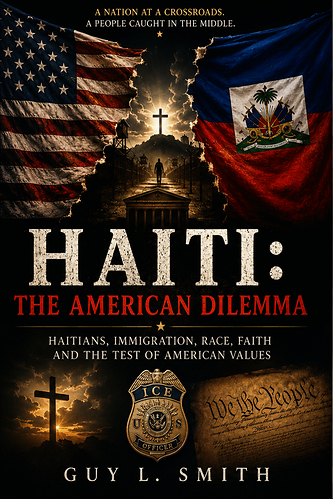
HAITI: The American Dilemma! examines the history of U.S.–Haiti relations and connects that history to contemporary immigration enforcement, asylum, detention, deportation, race, faith and constitutional due process. The book is available in paperback and as a Kindle eBook on Amazon.
Media Contact
Guy L. Smith, Votary Niccolò LLC, 1 203-273-8149, [email protected]
SOURCE Votary Niccolò LLC

Share this article