
Noorda College of Osteopathic Medicine has partnered with Matic to integrate AI-driven clinical intelligence into medical training. Students will gain hands-on experience with Scribematic, Matic's AI-native documentation platform embedded directly within real-world EHR workflows. The partnership prepares future physicians to work confidently in AI-enabled clinical environments, reinforcing clinical reasoning, preserving human judgment, and connecting documentation to the broader care-to-collection lifecycle.
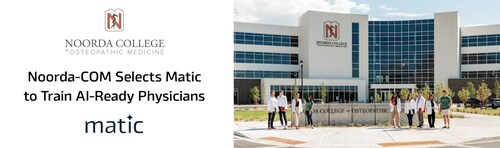
DALLAS, March 3, 2026 /PRNewswire-PRWeb/ -- Noorda College of Osteopathic Medicine (Noorda-COM) and Matic today announced a partnership designed to prepare medical students for the realities of modern clinical practice, where AI supports the entire care-to-collection workflow, documentation happens inside the Electronic Health Records (EHR) and AI-driven clinical intelligence is embedded directly into care delivery, while clinical judgment remains human.
Rather than introducing just another AI scribe, Noorda-COM selected Matic, an AI-driven, orchestrated care-to-collection clinical intelligence platform, giving students hands-on experience with Matic's flagship AI-native documentation solution, Scribematic, embedded directly into clinical workflows. This gives students hands-on experience with AI-assisted documentation in the same environments and workflows they will encounter in residency and practice.
This decision was informed by both real-world performance and independent validation. Matic was recently recognized by KLAS Research, the healthcare IT industry's most trusted source of provider-validated insights, as an Emerging Company in AI-driven clinical accurate and customizable medical documentation and intelligent workflows, based on verified clinician feedback, high satisfaction, measurable time savings, reduced burnout, and 100% repeat-buy intent.
KLAS recognition played a meaningful role in Noorda-COM's evaluation, providing independent confirmation that Matic performs reliably in real clinical environments. KLAS also cited reliability, customization, and highly responsive, clinician-facing vendor support, factors Noorda identified as critical when introducing AI into medical education.
Preparing Students for the Full Reality of Clinical Care
Medical education faces a growing challenge: students must learn how to think like clinicians while navigating documentation, compliance, and downstream care requirements that now extend far beyond the visit note. Noorda-COM's goal was not to outsource documentation, but to train better doctors, who understand what belongs in the note, what doesn't, how clinical intent carries forward, and how AI can responsibly support care without replacing human judgment.
Why Noorda-COM Chose Matic
Noorda-COM evaluated a range of AI documentation and workflow tools, including generic AI scribes and horizontal AI models, but identified clear gaps between transcription tools and systems capable of supporting real clinical education. Noorda-COM identified a clear set of requirements for introducing AI into clinical training:
- A solution that works inside the EHRs used across Noorda-COM's clinical ecosystem, including Athena-based practices.
- Support for any specialty, patient scenario, or language encountered during training
- Technology that reinforces clinical reasoning, care quality, surfaces care gaps, and supports sound decision-making, not just note completion
- A platform students can grow with, from clinical rotations through residency and into independent practice
- A partner with proven execution and support, validated in real clinical environments
Matic's AI Scribe, Scribematic, met those requirements as the first experience students encounter. It introduces high-quality clinical documentation while demonstrating how clinical intent carries forward into summaries, coding, and downstream workflows. Students can compare their own notes against AI-supported documentation, see what strengthens or weakens a clinical narrative, and identify missed questions or care gaps as teachable moments, without disrupting patient interaction. Over time, this helps students understand not just how to document care, but how care moves through the broader clinical and operational lifecycle.
Noorda-COM also saw this partnership as a meaningful way to thank and support physicians who train Noorda-COM medical students as community preceptors. As part of the program, all participating preceptors receive access to Scribematic, providing immediate value in their day-to-day practice.
This directly strengthens the student experience. When preceptors and students use the same intelligent documentation framework, education becomes more practical and aligned with real-world workflows. Students learn not just how to document care, but how clinical reasoning, documentation quality, and downstream workflows connect, preparing them for the way medicine is actually practiced today.
"This partnership reflects our commitment to prepare students for the medicine they will actually practice," said Michael Rhodes, Associate Dean for Graduate Medical Education and Continuing Medical Education, CMO | DIO at Noorda College of Osteopathic Medicine. "That means delivering a well-rounded clinical education that supports both learners and the preceptors who train them. Our graduates will work across a wide range of practice settings where AI is increasingly part of everyday workflows. Matic supports learning by modeling high-quality documentation, reinforcing clinical reasoning, and fitting naturally into real clinical environments, without interfering with patient care."
Built From the Student Experience
The partnership carries special significance because Matic was born inside Noorda-COM's clinical training environment. Alex Sheppert, DO, PhD, MBA, founder of Matic, began developing Scribematic while he was a Noorda-COM medical student during clinical rotations. Trained first as an AI engineer and lifelong programmer, Sheppert entered medicine to understand firsthand how documentation demands affect learning, patient interaction, and clinical judgment. Scribematic reflects that dual perspective, built by someone who has been the student, the engineer, and the physician.
A Platform Students Learn From Over Time
Scribematic is the first of several purpose-built AI solutions called "The Matics" that students may encounter within the Matic platform, introducing the concept of intelligent care, where clinical, operational, and financial workflows are connected through a continuous layer of AI-driven context. Rather than treating documentation, decision-making, and follow-up as separate steps, Matic supports care-to-collection workflows the way clinicians actually work. This progression gives students early exposure to AI-enabled clinical intelligence before residency, helping them understand how documentation, care decisions, and downstream outcomes are inherently connected in real practice.
As students progress, they may also choose to learn from:
- Summatic — Clinical Intelligence & Continuity: Summatic maintains longitudinal clinical intelligence across encounters and settings, generating concise summaries that reflect the full patient story. By preserving context over time, Summatic reduces redundant chart review, supports cleaner handoffs, and enables more informed clinical decision-making.
- Codematic — Clinical-Intent Coding: Codematic aligns documentation to coding requirements without breaking clinical intent, producing ICD-10–ready, CPT-aligned documentation that reflects current payer policies and medical necessity standards. By identifying documentation gaps that impact coding completeness and defensibility, Codematic improves first-pass acceptance, reduces denials, and lowers audit risk.
- Flowmatic — Care Flow Orchestration: Flowmatic coordinates care across teams and settings by maintaining shared clinical context, decisions, and follow-up actions throughout the patient journey. It replaces fragile handoffs and copy-paste workflows with reliable execution across inpatient and hospital-based environments.
- Pulsematic — Clinical Inbox & Prioritization: Pulsematic brings order to high-volume clinical inboxes by unifying messages, labs, refills, and requests into a single, prioritized view. It separates work requiring physician judgment from routine tasks, reducing cognitive load, decision fatigue, and after-hours work without interrupting care delivery.
Together, these capabilities give students and physicians a practical connected view of how intelligent care, documentation, workflow, and follow-up fit together in real clinical environments, without forcing them to manage multiple disconnected tools.
A Category-Defining Approach to AI in Medical Education
"This partnership isn't about teaching students how to use a tool," said Calvin Carter, CEO of Matic. "It's about teaching medical students how medicine actually works in an AI-enabled world. Generic AI tools stop at transcription. Matic was built to model clinical thinking, preserve intent, and carry context from care-to-claim. Noorda-COM chose us because they needed the best possible expert in the room, not just to document care, but to help train the next generation of physicians to deliver it well."
As AI becomes unavoidable in clinical workflows, medical education must prepare physicians to work with these systems responsibly, not encounter them for the first time in residency.
By embedding AI responsibly and transparently into clinical training, Noorda-COM is giving students real-world experience with the systems, workflows, and expectations they will face in residency and practice, while reinforcing that AI supports care, it does not replace clinicians.
About Matic
Matic is an AI-native clinical intelligence platform designed to orchestrate care-to-collection workflows the way clinicians actually practice. Through a growing suite of modular AI Agentic solutions Matic connects clinical documentation, summaries, coding, workflow, and follow-up into a unified and connected intelligence layer that preserves clinical intent, reduces fragmentation, and integrates seamlessly within existing physician systems. To learn more about how Matic orchestrates intelligence across the care-to-collection lifecycle, visit https://maticinside.ai
About Noorda College of Osteopathic Medicine
Noorda College of Osteopathic Medicine (Noorda-COM) is shaping the next generation of compassionate, practice-ready physicians through an innovative approach to medical education. Located in Provo, Utah, Noorda-COM is fulfilling its mission of addressing physician shortages and expanding healthcare access across Utah and the Mountain West. The college's curriculum blends active, small-group learning with advanced laboratory experiences and research opportunities, while prioritizing student wellbeing and work-life balance. Noorda-COM is a private institution dedicated to developing residency-ready physicians committed to patient-centered care and prepared for the evolving realities of modern medicine. For more information, visit noorda.edu.
Media Contact
Shannon Prager, Matic, 1 2142287883, [email protected]
McKay Sainsbury, Noorda-COM, [email protected]
SOURCE Matic

Share this article