Case study finds nearly 9 in 10 actionable cancer data points existed only in unstructured text invisible to standard EMR reporting; OncoLens Analytics helped the center lift on-time plastic surgery referrals from 58% to more than 83%, eliminate a 6-to-12-month registry lag, and reinforce data readiness for the center's National Accreditation Program for Rectal Cancer (NAPRC) accreditation
ATLANTA, Aug. 26, 2026 /PRNewswire-PRWeb/ -- OncoLens, a provider of real-time, AI-powered analytics for cancer programs, today announced results from a case study conducted with a large academic cancer center in Florida, showing how the OncoLens Analytics platform helped the center's navigation, registry, and surgical teams uncover care delays that were effectively invisible inside the electronic medical record (EMR), and act on them in real time.
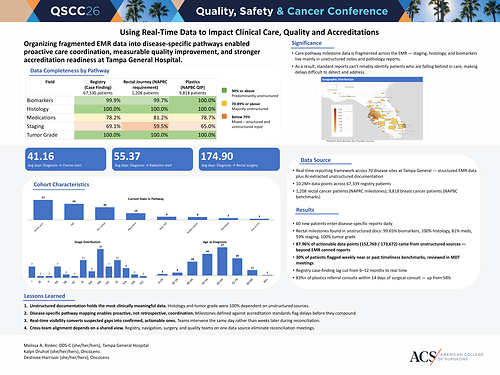
Cancer programs generate enormous volumes of clinical documentation, but much of the most clinically meaningful detail, including MRI performed dates, tumor histology, staging, genetics eligibility, and referral status, is recorded only in narrative text such as radiology impressions, pathology reports, and navigator notes. Analyzing more than 10.2 million data points across 67,339 patients, the center found that 87.96% of actionable clinical data originated from unstructured sources that its standard EMR reports could not surface. Before adopting OncoLens Analytics, tracking a single rectal cancer cohort, required manually mining 67 data fields per patient across 205 patients a year, at a cost of roughly 75 minutes of chart review per patient.
Those blind spots carried real consequences for patients. Registry case-finding lagged 6 to 12 months behind actual patient volume, delaying recognition of quality gaps such as missed genetics testing. And only 58% of eligible breast cancer patients received a plastic surgery consultation within 14 days of their surgical consult, a delay patients felt long before it showed up in any report.
OncoLens Analytics consolidates structured and unstructured clinical data into a single, real-time, patient-centered view of the cancer journey, from diagnosis through registry readiness and referrals. Using AI-powered extraction, the platform surfaces milestones buried in free text, such as an MRI performed at an outside facility and documented only in a narrative note, as soon as they are recorded, rather than weeks later.
Since implementing OncoLens Analytics, the center has seen:
- Real-time registry case-finding that eliminated the prior 6-to-12-month lag, giving navigators same-day visibility into which patients meet genetics-testing criteria.
- More than 83% of plastic surgery consults scheduled within 14 days of surgical consult, up from 58% , closing a 25-percentage-point gap that patients feel directly.
- A shift in how staff spend their time, with hours once spent mining charts and reconciling spreadsheets redirected to patient follow-up and quality improvement.
"The real-time aspect of OncoLens Analytics has transitioned my workflow from collection to high-value clinical intervention by identifying patients with a single line of clinically relevant, now-surfaced data. The patients can now be discussed at conferences and in other treatment planning meetings," said a clinical program leader at the center.
"This case study is exactly why we built OncoLens. The data cancer teams need almost never lives in a structured field — it's buried in a radiology impression or a navigator's note. When you surface that information in real time, you don't just save staff time, you close gaps that directly affect how quickly a patient moves from diagnosis to treatment. That's the difference we want every cancer program we work with to feel." — said Anju Mathew, CEO of OncoLens.
The center's experience reflects a broader pattern OncoLens sees across its customer base: cancer programs sit on far more actionable data than their EMR reporting tools can reach, and surfacing it in real time turns delay detection from a retrospective exercise into a same-day intervention.
Read the full case study here.
Media Contact
Destinee Harrison, OncoLens, 1 6318275594, [email protected], oncolens.com
SOURCE OncoLens

Share this article