Study from UOAA shows how Medicare's Competitive Bidding Program could disrupt current patient stability for people dependent on prosthetic ostomy supplies to live healthy and independent lives after surgery. Survey results support the need for the Access to Medical Supplies Act.
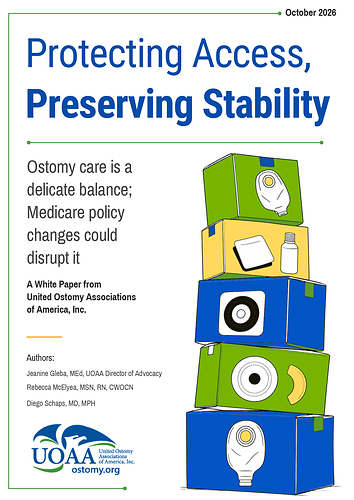
BIDDEFORD, Maine, Nov. 4, 2026 /PRNewswire-PRWeb/ -- Recognizing the significance of the Centers for Medicare & Medicaid Services (CMS) final policy ruling to include ostomy supplies in the Medicare Competitive Bidding Program, United Ostomy Associations of America, Inc. (UOAA), in partnership with Duke University, conducted a confidential national survey of 2,504 respondents to capture the patient experience before implementation of the next round of competitive bidding in 2028 and establish an objective pre-implementation benchmark. Today, UOAA released its findings in a White Paper entitled Protecting Access, Preserving Stability Ostomy care is a delicate balance; Medicare policy changes could disrupt it.
"The survey is essential to establishing a clear, data-driven baseline of patient experiences before competitive bidding takes effect. Now, with these results, we have the evidence needed to measure the program's real-world impact and hold CMS accountable for ensuring that access, product stability, and patient safety are not compromised," says UOAA President, Justus Anderson.
The survey's primary finding is that Original Medicare beneficiaries with ostomies have achieved a high degree of clinical stability under current Medicare coverage. 77% have used their current ostomy supply pouching system for at least one year, 27% for more than five years. Notably, more than two-thirds (68%) reported that they chose their current ostomy supplies specifically to prevent medical problems. This stability depends on reliable access to products that meet individual needs, help prevent complications, and support continuity of care.
The CMS Competitive Bidding policy change for 2028 would set fixed payment amounts and dramatically change the number of ostomy product suppliers available to Original Medicare beneficiaries. CMS describes Round 2028 as a nationwide Remote Item Delivery program and will award six contracts for ostomy supplies, as compared to the more than 800 suppliers currently serving the ostomy community. This structure creates a potential pathway for disruption in continuity if a beneficiary's established supplier is not awarded a contract or if the beneficiary has difficulty obtaining needed products or support from a contract supplier.
"Those of us who have ever lived with an ostomy know that these supplies are not interchangeable," says UOAA President Justus Anderson. The survey provides evidence of this. Among the 66% of respondents who tried other brands and products, 93.7% reported that alternative products did not work well. The Competitive Bidding program was intended for interchangeable commodities such as walkers and hospital beds, not highly individualized supplies that are used to achieve a prosthetic fit to replace the function of a lost body organ.
The survey also identifies vulnerabilities within the current supply system. Respondents reported delayed shipments, insurance-related barriers, reduced supply quantities, supplier changes, and product substitutions. When these disruptions occurred, respondents described leakage, peristomal skin complications, increased supply utilization, clinician visits, emergency department visits, and hospitalizations.
CMS has emphasized a commitment to protecting beneficiary access under the Competitive Bidding Program. However, the structural design of competitive bidding heavily pressures the six in-network contract suppliers to narrow brand availability based on price margins rather than an individual's custom clinical prescription. This threatens access to the ostomy community.
Meaningful access exists only when a Medicare beneficiary can obtain the clinically appropriate products and quantities needed to maintain an established, stable ostomy system without avoidable interruption or non-medical substitution with ineffective alternatives.
This survey's objective baseline data provides an opportunity for policymakers to evaluate whether implementation preserves the conditions that currently support patient stability, safety, and appropriate access to medically necessary ostomy supplies.
The release of these results coincidentally coincides with the recent introduction of the bipartisan Access to Medical Supplies Act (H.R. 10787). This survey could be a valuable tool for Congress as they consider the need for this legislation to protect users of ostomy supplies.
UOAA supports the Access to Medical Supplies Act, which would exclude ostomy supplies from the Medicare Competitive Bidding Program for five years and establish a technical expert panel to analyze whether these items are appropriate for competitive bidding and how to implement such a program. UOAA urges Congress to pass this bill to preserve access and protect the safety of the ostomy community. UOAA also calls on advocates across the country to contact their Representatives and ask them to co-sponsor the bill.
All results, UOAA policy recommendations, and the CMS response to the ostomy community's concerns are in UOAA's White Paper: Protecting Access, Preserving Stability. Ostomy care is a delicate balance; Medicare policy changes could disrupt it.
Media Contact
Ed Pfueller, United Ostomy Associations of America (UOAA), 1 8008260826, [email protected], United Ostomy Associations of America
SOURCE United Ostomy Associations of America (UOAA)

Share this article