PDS Optical has announced the publication of its milestone white paper, "Pulse on Digital Strain: Vision Health and Screen Use Among America's Military Veterans." The first-of-its-kind study examines daily screen time, digital eye strain, and benefit utilization within the U.S. Veteran community.
LOUISVILLE, Ky., Nov. 20, 2026 /PRNewswire-PRWeb/ -- PDS Optical, a service-disabled, Veteran-owned small business (SDVOSB) and leading provider of prescription eyewear to Veterans through the Department of Veterans Affairs (VA) health care system, today announced the publication of its milestone white paper titled "Pulse on Digital Strain: Vision Health and Screen Use Among America's Military Veterans."
As the first research study dedicated to measuring daily screen time and digital eye strain specifically within the Veteran community, the white paper establishes a useful baseline on how digital device usage impacts the health, well-being, and benefit utilization of military Veterans across all service eras and branches.
Heavy Screen Use and Widespread Physical Symptoms
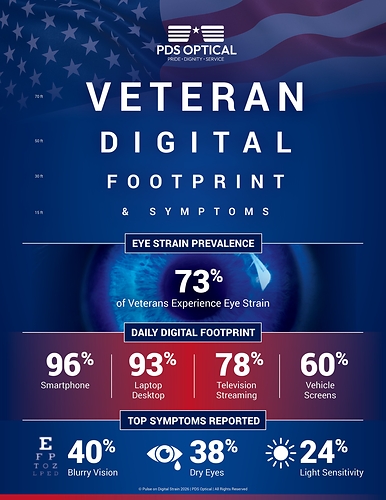
The findings reveal that modern Veterans live in a screen-saturated environment, using an average of four distinct digital devices daily. Smartphone usage is nearly universal at 96%, followed by laptop or desktop computers (93%), televisions or streaming devices (78%), and vehicle screens (60%). Screen time is primarily driven by entertainment (88%), communicating with family and friends (85%), and work (70%).
Against this backdrop of daily digital engagement, physical discomfort is widespread:
- High Symptom Rate: 73% of survey respondents report experiencing at least one symptom associated with digital eye strain.
- Primary Eye Strain Symptoms: The most common reported symptoms include blurry vision (40%), dry eyes (38%), and sensitivity to light (24%).
- Increased Daily Hours: Veterans experiencing eye strain symptoms log an average of two more hours of daily screen time than those who report no symptoms.
- Impact on Health & Wellbeing: 36% of Veterans state that screen time interferes with their sleep, 30% report interference with face-to-face interactions, and 68% express overall concern regarding their daily screen exposure.
Veterans who reported 6 hours of screen time daily were less likely to report screen-induced interference with sleep, social relationships, or overall well-being. However, a reported 10 to 12 hours of screen time marked a critical "demarcation line" triggering higher rates of sleep disruption, interference with face-to-face relationships, and visual strain.
The Confidence-Awareness Gap
The research highlights a significant disconnect between Veterans' confidence in federal healthcare systems and their knowledge of available vision services.
Two-thirds of Veterans surveyed report knowing little to nothing about the eye care and eyewear benefits provided by VA or TRICARE. Furthermore, roughly three in four Veterans say they are unlikely to seek professional consultation for eye strain, often quietly managing discomfort or viewing it as an unavoidable part of modern life. However, when asked directly, 87% of Veterans express full confidence in seeking care through the VA or TRICARE if guided to do so.
"This research demonstrates that Veterans aren't indifferent to their vision health, nor do they lack faith in the VA or TRICARE systems," said Sean Loosen, CEO of PDS Optical. "What exists is an awareness gap. Veterans are heavily reliant on screens for work and daily life, yet many quietly tolerate blurry vision or dry eyes without realizing that covered, high-quality care is already waiting for them. Our goal with this white paper is to bring this issue to light and help connect Veterans to the benefits they have earned."
Key Recommendations for Policymakers and Providers
To bridge the distance between everyday digital strain and accessible care, the white paper outlines several actionable recommendations for healthcare administrators, policymakers, and Veteran service organizations:
- Integrate Digital Eye Strain into Clinical Intake: Normalize eye strain discussions by embedding screening questions regarding daily device exposure and symptoms into standard VA and TRICARE clinical intake protocols.
- Unpack Care-Seeking Barriers: Conduct qualitative focus groups to determine whether hesitation to seek care stems from cultural stoicism, eligibility misperceptions, or bureaucratic friction.
- Segment Behavioral & Occupational Exposure: Analyze screen habits across specific Veteran cohorts to tailor visual performance education to administrative, operational, or logistics roles.
- Preventative Visual Performance: Partner with clinical sites to pilot digital intake protocols and measure whether normalizing screen-health conversations improves long-term visual outcomes.
For more information or to access the full white paper, visit https://pdsoptical.com/inside-pds/pds-research/.
About PDS Optical: Founded in 1998, PDS Optical is a leading provider of high-quality prescription eyewear to Veterans enrolled in the U.S. Department of Veterans Affairs (VA) healthcare system. Headquartered in Louisville, Ky., PDS Optical is a service-disabled, Veteran-owned small business (SDVOSB) dedicated to serving our nation's Veterans with pride, dignity, and exceptional service. Learn more at pdsoptical.com.
Media Contact
Tory Hyde, Evocati Public Relations, 1 5712396847, [email protected], https://www.evocatillc.com/
SOURCE PDS Optical

Share this article