
Healthcare AI pilots die in the gap between a working model and a production-ready environment, with an estimated 80% never making it to production. Pegasus One's SONG framework gives healthcare leaders a diagnostic to predict, before they invest, whether an AI agent will scale or quietly stall 18 months in.
FULLERTON, Calif., July 7, 2026 /PRNewswire-PRWeb/ -- An estimated 80% of healthcare AI pilots never reach production, not because the underlying models fail, but because the data and workflow foundations around them were never production-ready. Pegasus One Health created the SONG framework to give healthcare leaders a way to tell the difference before they invest: a diagnostic model that predicts whether a healthcare AI agent will scale in production or stall in pilot.
SONG is built on a contrarian premise, that the AI model is not the bottleneck. The leading foundation models are already capable enough for most healthcare workflows. The real constraint is getting the right data to the right agent at the right moment, which is an interoperability problem, not an AI one. Pilots that treat interoperability as a "Phase 2" concern build intelligent agents on unreliable foundations, and that is where they break, often 12 to 18 months in, after the budget is spent.
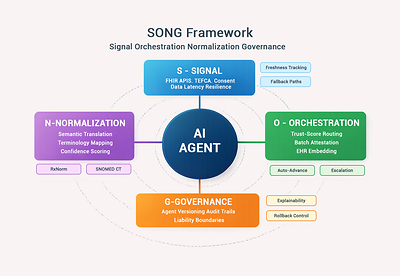
The SONG framework evaluates an AI agent across four pillars, each addressing a failure pattern that derails agents in production:
- Signal: Can the AI agent reliably obtain the right clinical data at the right time, accounting for FHIR availability, TEFCA connectivity, and data latency?
- Orchestration: Does the AI agent fit into clinical workflows without creating new burdens, such as review fatigue?
- Normalization: Can the agent resolve semantic inconsistencies between systems that speak FHIR but not the same clinical language?
- Governance: Can every agent decision be defended in an audit or a court, with versioning, audit trails, and clear liability boundaries?
"Everyone's debating which model is most accurate. It's the wrong conversation," said Tushar Puri, CEO of Pegasus One. "The models are not the bottleneck. What determines whether a healthcare AI agent survives contact within a hospital environment is whether it can get the data it needs, when it needs it, in a form it can use, and whether you can defend its decisions later. SONG gives healthcare leaders a way to see that before they invest, not 18 months later when the pilot quietly stalls."
Our approach is grounded in production results, not theory. In a recent deployment, we replaced a manual insurance-eligibility verification workflow (which took an average of four minutes per case across multiple payer portals) with an AI agent that completed the same work in eleven seconds, at the same volume and with a higher degree of accuracy. The improvement was not simply performing manual steps faster, but from collapsing a multi-portal process into a single loop, with a confidence score on every result and ambiguous cases routed to a human. The same calibrated-automation principle SONG's Orchestration and Governance dimensions formalize.
At Pegasus One, we apply SONG across four high-impact agent archetypes: Prior Authorization, ED Medication Reconciliation, Rural Chronic Disease Management, and the Da Vinci "Triple Play" for clearing houses and infomediaries.
You can evaluate your own readiness through a free SONG Readiness Assessment, available at pegasusone.health/assessments/song. Full details on the framework are available at pegasusone.health/song-framework.
Media Contact
Tushar Puri, Pegasus One, 1 (714) 485-8104, [email protected] , https://pegasusone.health/
SOURCE Pegasus One



Share this article