
The defense tech company integrated a multi-vendor sensor network for the 1st Cavalry Division in weeks, creating a responsive air defense layer.
EL SEGUNDO, Calif., Jan. 23, 2026 /PRNewswire-PRWeb/ -- Picogrid recently supported Army testing efforts at the National Training Center (NTC) in Fort Irwin, California. Working with the 1st Cavalry Division, Picogrid demonstrated how rapidly integrating sensor networks through an open integration layer can enhance force protection and maneuver awareness as the Army advances its modernization efforts.
Under the Army Transformation Initiative, Soldiers are training and deploying with next-generation equipment that will give them an advantage on the battlefield. General Randy George, the Chief of Staff of the U.S. Army, recently described how Soldiers should feel empowered to become subject matter experts on new technologies so their feedback can inform the Army's research, development and procurement decisions: "We want to give things to units and let you tell us what works, what doesn't, and you should be the ones deciding what we buy and don't buy. It has been unit leaders who have told us what our new mobile brigades are going to look like."
The U.S. Army's NTC has long served as the proving ground for how units fight, adapt, and integrate new capabilities under realistic operational conditions. During the 26-02 rotation, the 1st Cavalry Division leveraged that environment to advance its Army Transformation Initiative objectives—bringing together emerging technologies, operational experimentation, and an ambitious approach to modernization.
Prior to their NTC rotation, the 1st Cavalry Division worked with a range of sensor providers across radio frequency (RF), acoustic, and radar modalities, evaluating how different detection approaches could complement one another in complex training scenarios.
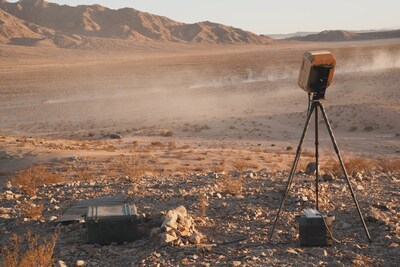
Building on initial sensor testing, Picogrid leveraged its integrated software and hardware stack to orchestrate disparate systems through its integration layer, Legion. Within a matter of weeks, Picogrid facilitated the integration of five different sensor products—including systems from DroneShield, R2 Wireless, Squarehead, Echodyne, and CHAOS Industries—allowing detections from multiple sensor types to be fused, correlated, and shared.
By combining inputs from passive RF and acoustic sensors with radar data, Picogrid enabled triangulation and track correlation to produce higher-fidelity UAS tracks. This multi-sensor approach provided operators with a more complete and resilient understanding of the airspace, demonstrating how layered sensing can enhance situational awareness and operational resilience in contested environments.
The integrated setup also allowed the unit to experiment with how sensors are employed in dynamic environments. The Army operators defined protection areas around maneuver elements and key assets, enabling passive sensors to monitor activity continuously while selectively activating radar only when needed. This approach supported refined tracking while limiting unnecessary emissions, illustrating how software-enabled integration can support more adaptive and survivable operations.
"It was inspiring working alongside Soldiers from the 1st Cavalry Division. Their leaders and operators had energy and determination to work hard on hard problems," said Jake Jeffries, Head of Deployments and Partnerships at Picogrid. "Our team was enabled by them to do incredible work, getting to prove the value of the Picogrid approach to connected command and control. That collaboration between military and industry is essential to advancing innovation across the defense ecosystem."
Beyond local sensing, Picogrid helped ensure that data generated during the rotation could contribute to the Army's broader command-and-control ecosystem. Sensor data was converted into Integrated Sensor Architecture formats and passed into Forward Area Air Defense Command and Control (FAAD-C2) systems, allowing information collected at the tactical edge to populate common operating pictures used across the force. This demonstrated how new capabilities can align with existing Army programs while supporting continued modernization.
The rotation also highlighted the unique challenges associated with protecting maneuver forces in modern conflict, where threats evolve quickly and units must operate across wide areas with limited time to react. By supporting experimentation at scale, Picogrid helped demonstrate how integrated software infrastructure can enable units to push the bounds of innovation—connecting sensors, sharing data, and adapting tactics in ways that keep pace with emerging operational demands.
Picogrid plans to continue supporting future exercises and training events as the Army advances its modernization efforts, building on lessons learned and reinforcing the value of rapid integration and close collaboration between government and industry.
About Picogrid
Picogrid is a technology company that builds products to integrate mission-critical systems. Its hardware and software products connect sensors, unmanned platforms, and digital systems, enabling unified control and data flow in defense and industrial environments. Deployed globally and supported by leading Silicon Valley investors, Picogrid delivers infrastructure for mission execution across land, sea, air, and space. Learn more at picogrid.com.
Media Contact
Casey Dell'Isola, Picogrid, 1 5806090819, [email protected], www.picogrid.com
SOURCE Picogrid


Share this article