
PsychAssist.ai moves beyond report generation with a clinical reasoning engine that works across the entire patient file, connecting psychometric data, clinical history, and session observations into defensible reports while keeping every diagnostic decision firmly in the clinician's hands.
KALAMAZOO, Mich., Sept. 8, 2026 /PRNewswire-PRWeb/ -- PsychAssist.ai, a clinical workflow platform engineered specifically for clinical psychologists, neuropsychologists, and assessment specialists, today announced the launch of its next-generation AI-assisted report writing platform. The release transforms one of healthcare's most demanding administrative bottlenecks: the multi-hour synthesis and report-writing process required for comprehensive psychoeducational, ADHD, autism, and neuropsychological evaluations.
Across the United States, waitlists for diagnostic testing from ADHD and autism evaluations to complex neuropsychological assessments can stretch to six months or longer. While testing batteries and patient interviews take hours to conduct, synthesizing raw psychometric data, clinical histories, and behavioral observations into standard 15-to-25-page narrative reports routinely takes longer than the testing itself.
While most solutions treat AI as a faster typewriter, PsychAssist.ai treats the entire assessment pipeline as a single unified reasoning engine, delivering a report that is auditable, defensible, and true to the patient.
PsychAssist.ai's clinical reasoning engine works across the entire case, connecting psychometric scores, clinical history, testing observations and intake data into a single evidence-backed clinical record. Rather than simply generating narrative text, it surfaces patterns and supporting or conflicting evidence, traces conclusions back to their source, and gives clinicians full control over what carries into the final report.
"Comprehensive psychological testing is critical for accurate diagnoses and patient outcomes, but the sheer administrative weight of drafting exhaustive narrative reports adds hours of typing on top of a formulation the clinician has already reached," said Dr. Chris Barnes, CEO of PsychAssist.ai and a practicing clinical psychologist. "We aren't replacing the clinician's diagnostic judgment. We automate the assembly, not the synthesis, and give psychologists their hours back for evaluating, diagnosing, and treating patients."
Beyond template text generation
Most AI tools in clinical documentation operate on one document at a time, assembling prose from templates and partial blocks. PsychAssist.ai operates on the whole case.
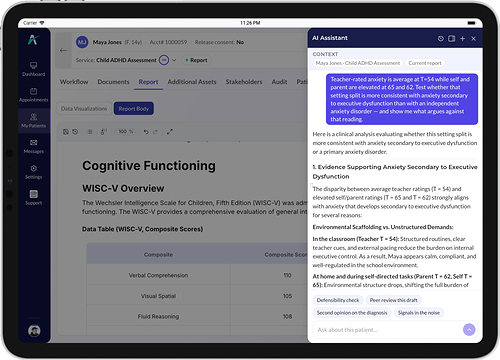
- Talk to the case file. Clinicians question scores, session observations, uploaded documents and intake forms in natural language, and get answers drawn from that patient's data rather than from a language model's general knowledge.
- Every claim carries its source. Diagnoses are tested against the patient's own dataset and presented with supporting, convergent and divergent evidence, each bullet cited to the measure, document, session note or observation it came from.
- Insights and Patterns. The platform surfaces cross-measure formulations, the kind a clinician recognizes but rarely has time to write out, with central, supporting and diverging evidence shown separately. The clinician chooses what carries into the report.
- Extraction is separated from interpretation. Uploaded documents are checked before they are trusted: all of the data fields, and a confidence score that flags an ambiguous handwritten digit rather than guessing at it. Nothing enters a report until the clinician approves it.
- Derivative documents from the finished evaluation. PCP summaries, therapist letters and plain-language one-page family summaries are generated from the same underlying record, each with its own editor and export.
Publisher-agnostic by design
Assessment batteries are rarely single-publisher. A comprehensive evaluation routinely combines cognitive testing from one publisher, behavior rating scales from another, a continuous performance measure from a third, and public-domain screeners alongside them. No single publisher's software can reason across a battery it did not publish.
PsychAssist.ai accepts score data from instruments published by Pearson, PAR, Multi-Health Systems, Western Psychological Services and Riverside Insights, alongside public-domain measures such as the PHQ-9, GAD-7 and Vanderbilt ADHD rating scales, and reasons across all of them as one body of evidence.
"Before implementing PsychAssist.ai, writing comprehensive neuropsychological reports meant giving up my evenings and weekends just to keep up with patient demand," said Yvonne Fritz, PsyD, Mojave Meadows Psychological Services. "PsychAssist.ai has fundamentally changed how my practice operates. It seamlessly structures my testing data into a clean, preliminary narrative draft while leaving every diagnostic decision entirely in my hands. It has shaved hours off every report without compromising an ounce of clinical precision."
The next-generation PsychAssist.ai assessment platform is available immediately for independent practitioners, group assessment clinics, and hospital-affiliated neuropsychology departments. To learn more or schedule a clinical demonstration, visit www.PsychAssist.ai
The Standard for Defensible AI Documentation
Alongside the release, PsychAssist.ai has published The Standard for Defensible AI Documentation, the requirements the company holds itself to for any AI-assisted psychological assessment report. The standard covers source provenance, mandatory surfacing of disconfirming evidence, clinician approval and accountability, and disclosure and auditability.
It is written to be applied to any system, including PsychAssist.ai's own, and is available here.
"A report that reads well and a report that holds up are not the same object," said Barnes. "We published the standard because a clinician signing their name to an AI-assisted evaluation deserves to know what was required of the software, and right now nobody is required to say."
About PsychAssist.ai
PsychAssist.ai is a clinical assessment platform for psychologists conducting psychological and psychoeducational evaluations. Founded by a practicing clinical psychologist, the platform combines assessment data management, cross-instrument clinical synthesis, and AI-assisted report writing in a single system, operating as a HIPAA business associate under signed Business Associate Agreements with zero patient data retained for model training. Learn more at www.psychassist.ai
Media Contact
Media Relations, PsychAssist.ai, 1 (269) 217-2262, [email protected], https://www.psychassist.ai/
SOURCE PsychAssist.ai

Share this article