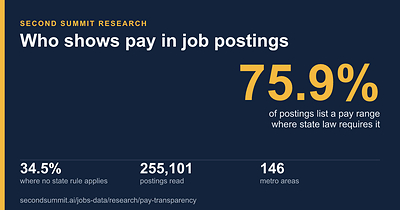
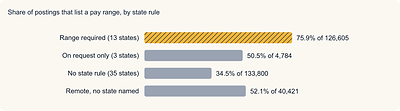
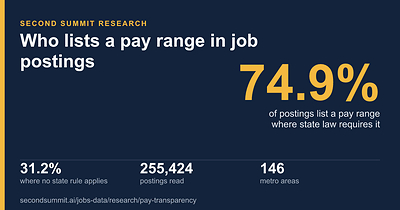
In a snapshot of 255,424 U.S. job postings, 74.9% listed a pay range in the 14 states and D.C. with posting disclosure laws, compared with 31.2% in states without a statewide posting disclosure rule. The study counts published pay ranges and excludes postings that list only a fixed rate.
ALPHARETTA, Ga., Nov. 10, 2026 /PRNewswire-PRWeb/ -- 74.9% of 140,719 postings in the 15 jurisdictions (14 states and D.C.) with a posting rule list a pay range, against 31.2% of 122,131 in the 34 states with no rule and 42.4% in the 2 states where the range is owed on request or later in hiring. The figures come from one read of 255,424 open postings on the career pages of 6,594 employers, and every metro figure carries a 95% model-based margin of error that assumes postings are independent. A posting that names more than one state counts in each, so the three groups total 265,529 and a posting can appear in more than one group. The measure counts published pay ranges and leaves out postings that list a single fixed rate, even where they disclose pay.
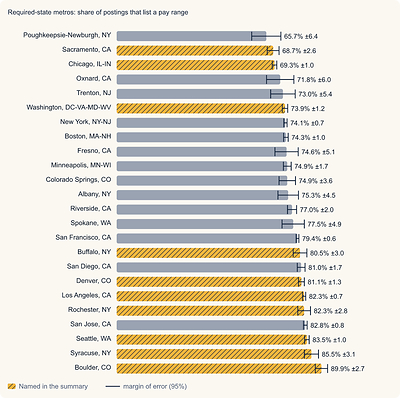
Holding the employer constant tells the same story: 1,045 employers post in both kinds of state, and 75.2% of their required-state postings carry a range against 35.2% elsewhere, a median gap of 8.7 points per employer. The pooled percentages weight each employer by how many postings it has, so they differ more than the typical employer does. Sacramento (68.7%), Chicago (69.1%), Richmond (70.7%) are the three lowest by observed share among the 14 qualifying metros with at least 1,000 postings in the sample; Boulder (89.9%), Seattle (83.5%), Denver (80.9%), Los Angeles (82.3%) and upstate New York lead.
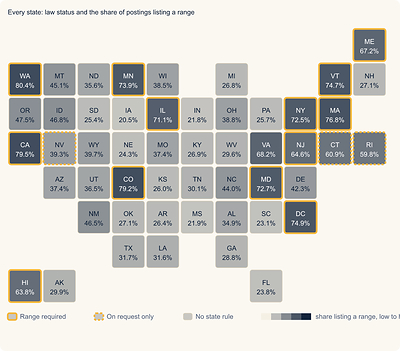
The research page carries the state map, ranked metro charts, the law table with each official source, the method a reporter can quote and CSV downloads, all free to reuse with credit and a link: https://secondsummit.ai/jobs-data/research/pay-transparency/. Custom cuts by metro, state, field or employer size are available on request.
"Too many job postings still leave out what the job pays. We counted the postings that list a pay range, state by state and metro by metro, so anyone can see where that information is easy to find and where it is still missing," said John Strommen, founder of Second Summit.
"This is a share of postings, not a compliance score. A small employer or a job that cannot be done in the state can leave pay out and be within the law. What the numbers show is how common it was in this snapshot to say what a job pays, state by state, and the gap is wide," Strommen said.
About Second Summit: Second Summit is a job-search product built by John Strommen after his own layoff. It finds open jobs on employers' career pages, tailors a resume to each one and helps with the application. Its research arm publishes free monthly job-market data by city, metro area and state.
Media Contact
John Strommen, Second Summit, 1 7707440285, [email protected], https://secondsummit.ai
SOURCE Second Summit

Share this article