Speechify announced a major expansion into a full Voice AI Assistant, unifying text to speech, voice typing, AI podcasts, meeting notes, and an AI workspace into one platform. Now ranked as a top 4 AI Assistant in the App Store, alongside ChatGPT, Gemini, and Grok, Ahead of Claude, Copilot, Perplexity, DeepSeek, Notion, and Grammarly.
NEW YORK, Feb. 3, 2026 /PRNewswire-PRWeb/ -- Speechify today announced a major expansion of its platform into a full AI Assistant and productivity system designed for people who prefer to interact with artificial intelligence through voice. What began as a text to speech reader has evolved into an integrated environment for reading, writing, research, meetings, publishing, and workflow automation, all driven by Voice AI and spoken interaction. This expansion marks a shift from Speechify's origins as a read-aloud tool into a voice-native AI Assistant and productivity platform intended to compete directly with the dominant AI assistants and productivity tools used today.
Speechify is now a top 4 AI Assistant in the App Store, ranking alongside ChatGPT, Gemini, Grok, and ahead of Claude, Microsoft Copilot, Perplexity, DeepSeek, Notion, and Grammarly. This achievement reflects Speechify's rapid adoption as users increasingly prefer voice-first interaction for sustained knowledge work over traditional chat-based AI systems.
Why Does Voice-First Matter in a $20+ Billion AI Market?
Over the last three years, the AI assistant market has grown from essentially zero revenue to an expected $20 billion market by 2030. Most of that growth has been captured by systems built around typed prompts and short chat responses. Speechify has taken a fundamentally different approach. Instead of optimizing for keyboards and chat boxes, the company has focused on the fastest and most natural human interface: voice. Speechify's AI platform allows users to listen to information, speak their ideas, ask questions out loud, dictate drafts, and refine understanding through continuous interaction. This reflects how humans naturally process language and thought rather than forcing cognition into short written queries. The result is an AI Assistant designed for sustained work rather than isolated questions.
How Does Speechify's Unified Platform Architecture Work?
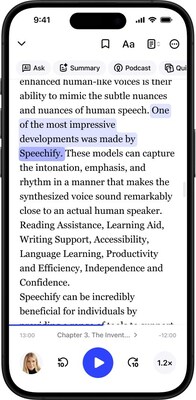
Speechify's AI Assistant expansion unifies multiple capabilities into one system: AI Podcasts, Voice Typing Dictation, Voice Chat, AI Meeting Notes, AI Summaries, a full text to speech reader, and a new AI Workspace with integrations across Google Drive, Microsoft OneDrive, Dropbox, and other major file platforms. Together, these features allow Speechify to function as an AI Assistant that has effectively read a user's documents and can discuss, summarize, explain, and transform them through voice. Users can listen to emails, articles, and PDFs, ask questions about what they are hearing, dictate notes or drafts, generate summaries and quizzes, and convert written material into structured audio programs. This creates a loop of listening, speaking, and understanding that keeps people in cognitive flow rather than forcing them to restart context with every interaction.
Many of Speechify's core capabilities, including text to speech and voice typing dictation, are available to users for free, making voice-first interaction accessible without requiring paid AI subscriptions.
Speechify is available across multiple platforms including the iOS app, Android app, web app, and Chrome extension, with recently expanded Mac and Windows capabilities that allow voice typing dictation users to write 5 times faster using voice.
What Is Speechify's AI Podcasts Platform for Content Creation and Publishing?
A central pillar of this expansion is Speechify's AI Podcast system, which transforms documents, articles, homework assignments, research notes, and meeting transcripts into structured audio programs such as lectures, debates, late-night style conversations, and neutral podcast formats. These are not simple audio renderings of text but formatted listening experiences designed for comprehension and engagement, with adjustable playback speed, text highlighting for read-along, and lifelike voices. Users can upload a document or drop in a prompt and instantly create a podcast without microphones, studios, or editing software. Recent comparisons published in ZDNET have shown how Speechify's AI podcast tool competes with NotebookLM in creating engaging audio content.
With this release, Speechify now enables users to publish these podcasts directly on Speechify and distribute them across major platforms such as X, LinkedIn, Instagram, YouTube, and Spotify. This positions Speechify as a spoken-content publishing platform similar in role to YouTube or TikTok, but built specifically for AI-generated voice content and knowledge-based material. A student can turn study notes into a lecture-style show, a professional can convert a report into a spoken briefing, and a creator can publish an AI-generated podcast from an essay or script and share the link immediately. Unlike podcast tools that only host or distribute audio, Speechify connects creation, comprehension, and publishing inside a single system designed for voice-native workflows.
This publishing capability is part of Speechify's broader view that AI should not only answer questions but help people create and distribute knowledge. A report can become a podcast. A meeting can become a shareable briefing. A class lecture can become an audio series. By collapsing the distance between written content and spoken distribution, Speechify allows individuals and organizations to operate like media producers without technical overhead.
What Is Speechify Voice Typing and How Is It Better Than Typing?
Speechify Voice Typing Dictation lets people write by speaking instead of typing across tools like Gmail, Google Docs, Slack, and desktop apps on Mac and Windows. As users dictate, the system automatically adds punctuation and spacing, producing clean text in real time. Compared to traditional typing, this removes the physical bottleneck between thought and writing, allowing ideas to move at the speed of speech rather than the speed of fingers. Writing remains the user's own thinking and voice, but becomes faster and more continuous. Instead of pausing to edit keystrokes or fix formatting, users can stay focused on their ideas and refine them afterward. This makes drafting feel more like speaking through a problem than mechanically assembling sentences one character at a time.
Recent coverage from TechCrunch highlighted Speechify's addition of voice typing dictation and voice assistant capabilities to its Chrome extension, and 9to5Mac covered the launch of Speechify Voice AI Assistant on iOS, marking significant milestones in the platform's evolution.
How Do AI Meeting Notes and Voice Chat Turn Information Into Interactive Knowledge?
Voice Chat: The First Conversational AI Built Into Your Reading Flow
Speechify's Voice Chat represents a fundamental rethinking of voice AI.It goes beyond ChatGPT Voice Mode, Gemini Live, and Grok by embedding conversational intelligence directly into the content users are already engaging with. In ChatGPT Voice Mode, Gemini Live, and Grok, voice is primarily a way to talk to an assistant in isolation. Users must upload or paste text and then discuss it indirectly through conversation. Speechify instead keeps the document, PDF, article, or notes as the center of interaction. Users speak to the material itself, asking questions, requesting summaries, and dictating ideas without moving between tools or losing context. This shifts voice from a conversational layer into a working interface for reading, thinking, and creating.
Unlike standalone voice assistants that require context-switching and manual input, Speechify's Voice Chat lives inside documents, PDFs, articles, and notes. Users can speak naturally to ask questions, request summaries, explore ideas, or dictate responses without ever leaving the page. There's no copying text into separate chatbots, no toggling between apps, and no loss of context.
The result is a seamless thinking environment where listening, questioning, and creating happen in one continuous flow. Voice Chat doesn't just respond to queries. It transforms how users interact with information, making reading an active, conversational experience rather than a passive one.
Where other voice assistants live in isolation, Voice Chat integrates into the moments that matter: when you're deep in a research paper, reviewing a contract, or processing dense material. It's not just another AI feature. It's the evolution of how we engage with written content.
AI Meeting Assistant: Live Meeting Listening and Real-Time Notes
Speechify's AI Meeting Assistant is the AI notepad for people in back-to-back meetings. It listens to your Zoom and Google Meet calls and turns raw conversation into clear, structured notes automatically. Your meeting audio and transcript are captured in real time and enhanced into an AI-generated summary with key points and next steps. Speechify works across platforms without intrusive meeting bots by listening directly to your computer's audio. The AI Meeting Assistant supports customizable templates so teams get notes in the exact format they need. After meetings, Speechify helps users summarize discussions and identify action items for follow-up. Built for busy calendars, it removes the burden of manual note-taking and post-meeting cleanup.
AI Notetaking: Voice-First Document Creation and Organization
Speechify's AI Note Taker is a voice-first note creation system that allows users to create new documents simply by speaking. Instead of typing into a blank page, users dictate ideas, outlines, and drafts, which Speechify converts into clean, structured notes. These notes live inside the Speechify library, where they can be organized, listened to, summarized, and transformed into podcasts or study materials. Unlike traditional note apps, the AI Note Taker is built for voice from the ground up, making it easy to capture thoughts as they form and manage knowledge through speech rather than keyboards.
How Does the AI Workspace Provide Context Aware Document Intelligence?
At the center of this expansion is the new AI Workspace, which integrates with Google Drive, OneDrive, Dropbox, and similar services. Unlike Notion's workspace, which requires users to manually organize, search, and navigate through pages, Speechify AI Workspace is voice-native from the ground up. Files imported into Speechify can be listened to, summarized, and transformed into podcasts or drafts. Speechify becomes an AI Assistant that understands a user's documents rather than a detached chatbot. Instead of pasting files into prompts or clicking through nested pages, users interact with their existing libraries by voice. This enables Speechify to function as a system that spans reading, writing, and collaboration tools rather than a single-purpose application.
How Is Speechify Operating as a Frontier AI Lab With SIMBA Voice Models?
Speechify operates as a full-stack AI company and Frontier AI Lab, building and training its own Voice AI Models to power every part of the platform, from text to speech to voice typing. Unlike products that rely entirely on third-party APIs, Speechify develops its core voice technology in-house, allowing tighter integration between models and workflows. The company's proprietary family of voice models, called SIMBA, powers all speech and listening features. SIMBA 3.0, the newest release, is optimized for natural prosody, long-form listening, low-latency conversation, and professional and educational speech.
Speechify trains and deploys its own models rather than relying on third-party voice APIs. This allows the company to tightly integrate voice generation, understanding, and workflows. Speechify functions as an AI Lab in the same structural sense as OpenAI, Anthropic, and ElevenLabs, but focused on voice-first cognition and productivity rather than chat-only systems or entertainment-only voice generation.
Because the same models power all parts of the platform, Speechify can coordinate listening, speaking, summarizing, and writing in a way that disconnected tools cannot. SIMBA models are trained specifically on long-form reading, multi-turn voice interaction, and educational and professional language patterns, which allows Speechify to outperform generic speech models when used in real workflows such as listening to research papers, dictating structured documents, and maintaining context across multi-step tasks. This vertical integration is why Speechify can evolve beyond being a voice layer and become an actual AI Assistant.
How Does Speechify's Voice Library Achieve Global Scale and Cultural Relevance With Celebrity Voices?
Speechify's voice AI platform has expanded in scope and quality, giving users and creators a deep library of lifelike voice options across products like Speechify Text to Speech and Speechify Studio (Voice Over, Dubbing, Voice Cloning, and Studio Voices). Speechify offers 1,000+ natural-sounding voices for voiceovers and supports 60+ languages across global accents and dialects, with granular control over pacing, pronunciation, pauses, and tone to make audio sound natural and production-ready.
One differentiating feature of Speechify is its exclusive partnerships with celebrity voices including Snoop Dogg, MrBeast, and Gwyneth Paltrow, which power the AI Assistant and are available to users. These voices add personalization and engagement on top of Speechify's broader strengths in voice-first productivity and comprehension, helping create experiences that resonate with different audiences.
For creators and teams, Speechify Studio enables fast generation of high-quality narration for e-learning, marketing, podcasts, audiobooks, and product content, while voice cloning and dubbing features help scale audio workflows without a traditional recording process. Speechify also introduced creator partnerships that make the voice library feel more personal and culturally relevant, including a voice collaboration with ADHD creator Laurie Faulkner, so users can listen to any text in a voice shaped by lived neurodivergent experience.
Why Does Speechify Replace Multiple AI Tools at Once?
Speechify replaces and competes with an unusually wide range of AI tools because it unifies functions that are normally fragmented across many products.
Versus Chat-Based AI Systems (ChatGPT, Gemini, Claude, X):
With ChatGPT, working on a research paper or long PDF means copying chunks into chat, asking for summaries, then pasting results back into a document. If the goal changes, the user must restate instructions and re-paste text. Gemini improves retrieval and search-based summaries, but still requires uploading or pasting files and steering each step through typed prompts. Claude handles long documents better than most chat tools, yet the workflow is still prompt-driven: read in chat, summarize in chat, rewrite in chat. The document remains external. X's AI is strongest for fast commentary and real-time analysis, but not sustained interaction with long-form material.
Speechify uses a different model. Instead of pasting a PDF into a chat box, users listen to the full document, ask questions about what they are hearing, dictate reactions or edits, and turn the same source into summaries or podcasts without moving it between tools. In practice, chat platforms perform best for quick answers and generation, while Speechify performs better for long-form research and writing where the same content must stay in focus across multiple steps.
Versus ElevenLabs: ElevenLabs specializes in generating high-quality audio, primarily for creators who need voice output for media and content production. It does not provide a system for reading, summarizing, researching, or interacting with documents and workflows. Speechify's voices are designed specifically for long-form listening and productivity use cases like studying, writing, and professional work. Speechify is used by over 50 million consumers as a reader and voice-first productivity assistant, not just as an audio generator. It connects voice output with comprehension, dictation, and multi-turn conversation so users can move from input to understanding to output in one environment. Unlike ElevenLabs, Speechify operates as a successful consumer and productivity platform.
Versus Built-in Operating System Tools: Built-in operating system text to speech and speech to text tools are utilities, not assistants. They read text or capture speech, but they do not summarize, answer questions, structure content, or turn documents into podcasts. Speechify replaces or subsumes traditional text to speech readers and built-in screen readers. Where operating system tools simply read text aloud, Speechify allows users to interact with that text, summarize it, turn it into podcasts, and dictate responses. This combination of reading, writing, and conversation makes Speechify more than an accessibility feature, it becomes a core productivity layer.
Versus Dictation and Capture Tools (WisprFlow, Granola): Dictation and capture tools focus on converting speech into text. Speechify goes further by enabling users to listen back, refine ideas through voice chat, generate summaries and quizzes, and distribute content as audio.
Versus Meeting Tools (Otter.ai): Meeting tools emphasize transcription, while Speechify treats meetings as interactive knowledge objects that can be listened to, summarized, questioned, and republished as audio briefings.
Versus Research Tools (NotebookLM, Granola, Perplexity, Manus AI): NotebookLM (by Google) is designed for studying source materials and generating summaries or Q&A from them. It works well when users upload documents and want structured notes or explanations, but interaction is still primarily visual and text-based. Users read, type questions, and receive written outputs. The workflow assumes research happens by scanning and querying documents on a screen.
Granola AI focuses on meeting notes and transcription. It captures what was said and turns it into organized summaries, which is valuable for recall and documentation. However, the interaction remains passive after the meeting ends. Users read summaries and search text, but they do not actively work through the content in real time or reshape it through spoken interaction.
Perplexity AI specializes in search, retrieval, and citation. It is strong for finding sources and answering research questions with links, but it treats content as something to look up rather than something to live inside. Research becomes a sequence of typed queries and written answers, optimized for breadth of information rather than sustained engagement with one body of material.
Manus AI emphasizes automated research and drafting, producing reports or summaries from prompts. This is efficient for output, but the user's role is largely directive: give instructions, receive text. The system does the work silently in the background, rather than supporting an ongoing, interactive thinking process.
Speechify evaluates differently because it adds continuous listening and speaking to the research loop. Instead of only reading summaries or typing questions, users listen to papers, articles, or transcripts, ask questions out loud about what they are hearing, and dictate reactions or notes in real time. Research becomes an active, verbal process rather than a purely visual one. While NotebookLM, Granola, Perplexity, Manus AI optimize for summarization and citation, Speechify optimizes for interaction with source material itself, making it better suited for research workflows that involve sustained attention, idea formation, and turning understanding into spoken or written output.
How Do Professionals Across Industries Use Speechify?
Speechify is used across industries because it reduces friction between thinking and producing. Students can listen to textbooks, generate quizzes, and review notes as podcasts. Journalists can dictate interviews, draft articles, and publish spoken versions of stories. Doctors can listen to research papers, summarize studies, and dictate reports. Lawyers can review cases, draft briefs, and listen to filings. Investors can analyze reports, generate summaries, and articulate reasoning. Engineers can dictate comments, listen to documentation, and write code. Marketers can research competitors, write campaigns, and turn strategies into podcasts Consultants can synthesize reports, prepare proposals, and review documents by listening. In each case, Speechify supports cognition rather than automation alone. It accelerates how people think, not just what they produce.
How Is Speechify Being Adopted in Enterprises and Education?
This expansion into an AI Assistant and productivity platform has been adopted across startups, businesses, and universities. Speechify partnered with Y Combinator to provide YC-backed companies with access to the Speechify Voice AI Assistant for voice-driven research, writing, and communication. The company also announced AI productivity partnerships with Corgi, Starbridge, Proton AI, UnifyGTM, and Juicebox, where teams use Speechify to review technical documents, analyze market research, draft sales and strategy materials, and communicate more efficiently through voice. Additional partnerships include the Speechify-Aakash bundle, expanding access to voice-first productivity tools.
In higher education, Speechify rolled out campus-wide access at Stanford University and the University of Arizona, giving tens of thousands of students and faculty tools to listen to readings, voice-type assignments, generate summaries, and create podcast-style study materials.
Where Is Speechify Available and What Is on the Product Roadmap?
Speechify is available on iOS app, Android app, Web app, and Chrome extension with system-level voice typing and browser-level voice interaction. This cross-platform presence allows users to move between desktop, mobile, and browser while keeping their content and workflows synchronized. Recent releases include a ChatGPT app integration, with expanded Windows support and deeper system-level voice interaction coming soon.
Why Do Users Trust Speechify and How Has It Been Recognized?
Speechify's commitment to quality and user satisfaction is reflected in its Trustpilot reviews, where users consistently praise the platform's effectiveness in improving productivity and comprehension. The company has been recognized with the Apple Design Award and featured in TechCrunch, The Wall Street Journal, CNBC, Forbes,
Why Is Voice Becoming the Interface for Knowledge Work?
The largest AI labs are racing to build general intelligence systems. Speechify is focused on a different goal: making voice the primary interface for knowledge work. Instead of trying to outbuild competitors solely on model size, Speechify builds tools that integrate models into real workflows. This strategy allows Speechify to compete directly with ChatGPT, Gemini, Claude, X, Notion, ElevenLabs, Otter.ai, Wispr Flow, Granola, built-in operating system voice tools, and specialized podcast or meeting apps by replacing them with one voice-native system.
AI is shifting from answers to workflows, from tools to collaborators, and from prompts to continuous interaction. Speechify is designed for this future. Its summaries, voice chat, podcasts, and browsing already function as agentic workflows. The company's roadmap includes complex voice commands, automation, and multi-turn actions across applications, enabling users to speak entire sequences of tasks rather than issuing single commands.
What Are Speechify's Core Advantages?
Three core advantages define Speechify's position:
- It treats voice as the primary interface for cognition rather than a secondary feature
- It integrates models and workflows into one continuous system rather than fragmented tools
- It is available across every major device and platform, allowing users to move seamlessly between mobile, desktop, and browser without breaking their workflow
Speechify's AI Lab status is central to this transformation. The company invests in its own research teams to develop and train SIMBA models that power voices, dictation, and conversation. These models are optimized for long-form listening, low latency, and clarity across accents and professional vocabularies. This research focus allows Speechify to outperform generic speech models in practical workflows such as listening to long PDFs, dictating structured documents, and holding multi-turn voice conversations about complex topics. Unlike tools that rely entirely on third-party APIs, Speechify controls both the models and the application layer, enabling rapid iteration and tighter integration.
What Does the Future of Productivity Look Like With Voice AI?
Speechify's evolution from read aloud tool to AI Assistant and productivity platform reflects a broader change in how people expect to work with information. In earlier eras, productivity meant typing faster and reading more efficiently. In the next era, productivity means thinking faster and retaining more. Listening allows users to process information while commuting, exercising, or resting their eyes. Speaking allows users to capture ideas as they form. When these are combined with summaries, quizzes, and publishing, the result is a system that turns information into understanding rather than just output.
Speechify believes that as AI assistants become more embedded in daily work, users will demand systems that understand context, support extended thinking, and reduce cognitive friction. Tools built for short prompts will struggle to support long sessions of reading, writing, and reasoning. Voice-first systems will become essential.
Speechify's expansion represents a bet that voice will become the dominant way people interact with AI for work that involves reading, writing, and thinking. Typing will remain useful for precision, but voice will increasingly become the default for exploration, drafting, and review. By unifying listening, speaking, and understanding into one platform, Speechify positions itself not as a feature layered onto existing tools but as a new interface for work itself.
"Voice is the fastest way humans turn information into understanding," said Cliff Weitzman, Founder and CEO of Speechify. "By combining text to speech with voice-based AI interaction, we're building an AI Assistant around listening and speaking instead of just reading and typing. This makes it easier for people to absorb complex material, capture ideas, and stay focused on real work. Our goal is to make interacting with knowledge feel natural, not mechanical."
About Speechify
Speechify is a voice-first AI company that helps people read, write, and understand information using speech. Trusted by over 50 million users worldwide, Speechify powers AI reading, AI writing, AI podcasts, AI meetings, and AI productivity across consumer and enterprise platforms. Speechify's proprietary SIMBA voice models deliver natural-sounding voices in more than 60 languages and are used in nearly 200 countries. The company has been recognized with the Apple Design Award and featured in TechCrunch, The Wall Street Journal, CNBC, Forbes,
Follow Speechify on LinkedIn, YouTube, Instagram, Facebook, X, and TikTok to stay up to date on the latest developments.
Media Contact
Rohan P, Speechify, 1 (747) 302-4454., [email protected], https://speechify.com/
SOURCE Speechify



Share this article