
Five named storms have formed this year, but none has reached hurricane strength, breaking the satellite-era record for the latest first hurricane of a season. FixMold Miami urges homeowners to use the lull to inspect common water-entry points before the season ends November 30
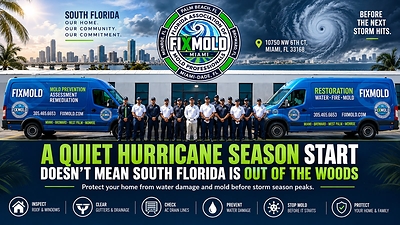
MIAMI, Sept. 20, 2026 /PRNewswire-PRWeb/ -- The Atlantic has broken the satellite-era record for the latest first hurricane of a season. The previous mark, September 11, was set by Hurricane Gustav in 2002 and matched by Hurricane Humberto in 2013; this year passed that date without a single storm reaching hurricane strength. Five named storms have formed so far this year, Arthur, Bertha, Cristobal, Dolly and Edouard, none stronger than a tropical storm. The National Hurricane Center has been tracking a disturbance east-southeast of Bermuda this week with a meaningful chance of development, which would become Tropical Storm Fay if it organizes. The remaining names on this year's list after Fay are Gonzalo, Hanna, Isaias and Josephine, a reminder the season runs through November 30.
A quiet stretch does not eliminate the possibility of a rapidly developing threat. Hurricane Andrew became a hurricane on August 22, 1992, intensified to Category 5 strength the following day, and struck southern Miami-Dade County on August 24, causing more than $25 billion in damage, at the time the costliest hurricane in U.S. history.
FixMold Miami, a South Florida mold remediation company founded by Abraham Katz, is encouraging homeowners to use the current lull to inspect the small structural and mechanical defects that can let rainwater into a property during wind-driven storms.
"Most homeowners prepare for major roof damage, broken windows and flooding, but mold problems can begin with a much smaller opening," Katz said. "Water entering through a failed seal, a hairline crack or a poorly draining HVAC component can reach insulation, wall cavities or ductwork without being immediately visible. Once water gets in, fast action and proper documentation matter."
Before the Storm: Seven Areas to Check
FixMold Miami recommends inspecting:
- Stucco and exterior wall cracks, including hairline cracks, separation near windows and doors, and gaps at expansion joints where wind-driven rain can enter behind the building envelope
- Roof flashing and penetrations around vents, chimneys, skylights and roof-to-wall transitions, for deterioration, lifting or damaged sealant
- Air-conditioning drainage components, including condensate lines, drain pans and exterior vent housings, for clogs, cracks, corrosion or improper drainage
- Exterior fixtures and storm hardware, securing shutters, gutters, downspouts and outdoor HVAC components, since loose hardware can create new water-entry points in high wind
- Mechanical wall penetrations, checking the sealant around refrigerant lines, electrical conduit, plumbing and cable penetrations, particularly on older installations
- Windows and exterior doors, inspecting weatherstripping, caulking, thresholds and perimeter seals for gaps or separation
- Gutters and downspouts, clearing debris and confirming water is directed away from walls and the foundation
When an inspection turns up a defect, the next step is determining whether it's a simple exterior repair or a sign that moisture has already reached concealed building materials or HVAC components.
After Water Intrusion: Dry, Document and Evaluate
Not every water event requires mold remediation service, but every intrusion should be evaluated based on its source, duration and the materials affected. EPA guidance recommends removing water promptly and drying affected areas within 48 hours when possible to reduce the likelihood of mold growth, though this is a risk-reduction measure, not a guarantee. Property owners should photograph visible damage, record when the intrusion occurred, stop the source when safe to do so, and avoid operating HVAC equipment if contamination or standing water may affect the system.
Porous materials, including drywall, insulation, carpet padding and some ceiling or duct materials, can retain moisture even after the surface appears dry. A qualified professional can help determine what can be dried and cleaned and what may need to be removed.
How FixMold Miami Evaluates Hidden Moisture
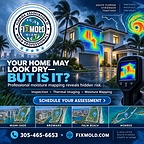
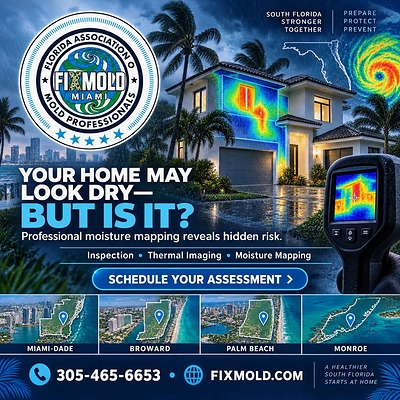
Depending on site conditions, FixMold Miami may use infrared thermal imaging to identify temperature anomalies, followed by direct moisture-meter readings on affected materials. When remediation is necessary, the scope may include containment, HEPA-filtered air control, removal or treatment of affected materials, detailed cleaning and post-remediation verification, as appropriate to the property.
"The objective isn't only to address visible mold," Katz said. "It's to identify and correct the moisture source so the same problem is less likely to come back."
About FixMold Miami
FixMold Miami is a family-owned South Florida company providing mold inspection, testing, indoor air quality services and remediation. Founded by Abraham Katz, the company says its team includes Florida-licensed mold professionals and IICRC-certified technicians serving Miami-Dade, Broward, Palm Beach and Monroe counties.
FixMold Miami reports more than 1,000 five-star reviews across platforms including Google and Yelp, and has been a BBB Accredited Business since 2023 with an A+ rating. For homeowners who want guidance before scheduling a visit, the company also offers FaceTime Mold Solutions, a free virtual consultation.
Media and Service Inquiries
FixMold Miami
Founder: Abraham Katz
Phone: 305-465-6653
Email: [email protected]
Website: https://fixmold.com
Service Area: Miami-Dade, Broward, Palm Beach and Monroe counties and surrounding South Florida communities.
Linkedin - https://www.linkedin.com/company/fixmoldllc/
Facebook - https://www.facebook.com/wefixmold/reviews
Instagram - https://www.instagram.com/fixmold/
Media Contact
Abraham Katz, FixMold, 1 3054656653, [email protected], https://fixmold.com
SOURCE FixMold





Share this article