The Inverted Realm examines how Bruegel's crowded visual composition can be reimagined for the stage through movement, rhythm and physical storytelling.
EDINBURGH, Scotland, Aug. 16, 2026 /PRNewswire-PRWeb/ -- Pieter Bruegel the Elder's Netherlandish Proverbs does not direct the eye towards a single dramatic centre. Across the painting, figures climb, quarrel, carry, fall and pursue their own concerns, with meaning emerging through the accumulation of actions across the wider composition.
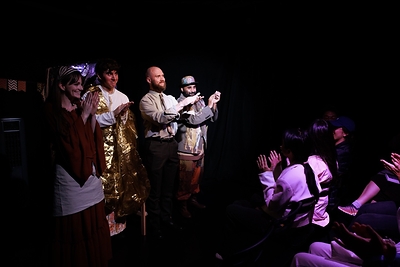
That quality provided a starting point for The Inverted Realm, presented at Greenside @ George Street from 7 to 15 August as part of the 2026 Edinburgh Festival Fringe. The work draws on Bruegel's crowded visual world through physical storytelling, movement, sound and surreal stage imagery.
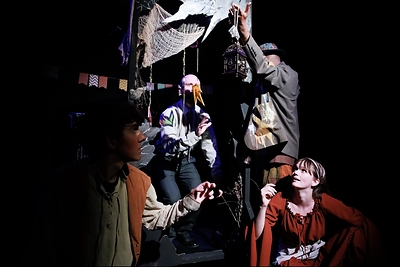
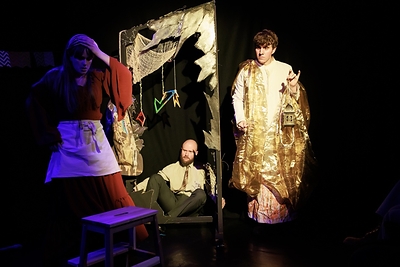
The play follows the Traveller, a driven businessman stranded after his car breaks down on a deserted road. His journey leads into a realm of upside-down houses, impossible birds, peculiar villagers and an elusive Fool who tells him that only the lost can be found.
Rather than assigning a separate scene to each proverb, the production takes inspiration from the way multiple actions coexist within Bruegel's painting.
On stage, movement, rhythm and visual composition help organise attention across the performance. Actions and characters are arranged within a larger stage picture, allowing individual moments to be seen in relation to the wider performance.
The approach is less concerned with reproducing the painting than with adapting aspects of its compositional logic for performance.
In Bruegel's work, the viewer is free to move between details and notice relationships that may not be apparent at first glance. The Inverted Realm retains something of that openness by allowing text, movement, sound and visual imagery to operate alongside one another.
This is particularly suited to the production's surreal world. A physical action may be read differently according to what surrounds it. Repetition can draw attention to a behaviour without immediately explaining it, while changes in rhythm and stage composition can shift the audience's focus between individual characters and the wider ensemble.
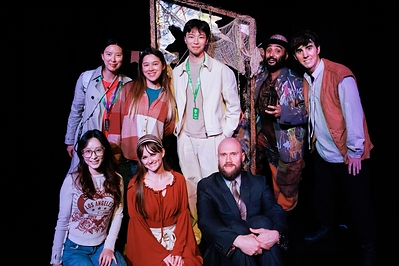
Conceived and produced by Xingyun Zhao, the project developed around the possibility of allowing theatrical form to carry part of the meaning rather than relying on explanation alone. The production leaves space for images and actions to be observed before they are given a fixed interpretation.
The creative team includes practitioners from different cultural and artistic backgrounds, working across text, movement, sound and visual design. Create Abundance Foundation served as an academic consultant to the project.
Bruegel's painting remains the source, but not a blueprint. What passes from canvas to stage is less a catalogue of individual proverbs than a way of placing human actions beside one another and allowing relationships to emerge through observation.
Theatre changes the conditions of that observation. A painted gesture acquires duration. A figure becomes a performer sharing space with others. Actions that remain suspended on canvas unfold in time.
The Inverted Realm uses those differences between painting and performance as part of its theatrical language.
It does not seek to explain Netherlandish Proverbs. It responds instead to the way Bruegel arranged human behaviour within a single, crowded world.
Media Contact
Xingyun Zhao, The Inverted Realm, 971 562733888, [email protected]
SOURCE The Inverted Realm

Share this article