
Timbo Robot introduces a screen-free, motion-based coding system that transforms computational thinking into a hands-on, intuitive learning experience. By bridging tangible interaction and hybrid digital expansion, it redefines how children develop problem-solving skills through play.
SEOUL, South Korea, Feb. 26, 2026 /PRNewswire-PRWeb/ -- Computational Thinking: The Core Competency for the Future
In future society, problem-solving competency will be more critical than ever.
This transcends mere knowledge acquisition; it is a high-level cognitive ability to analyze, structure, and autonomously derive solutions. Pedagogically, this is most effectively nurtured through Computational Thinking (CT). Consequently, various educational approaches are being implemented, with coding education emerging as a core solution for thought-oriented learning.
The essence of coding education does not lie in mastering specific programming languages or technical skills. Its primary objective is to experience Decomposition, Pattern Recognition, Abstraction, and Algorithm Design, thereby developing the capacity to understand cognitive structures and express them logically. True coding education empowers children to think independently through play and exploration, growing their problem-solving capacities by transforming thoughts into executable forms.
However, the current educational landscape remains dominated by grammar-heavy instruction and result-oriented learning. This causes coding to be perceived as a burdensome academic task rather than a joyful tool for thinking—a clear limitation where the tool precedes the thought.
Tangible User Interface (TUI): Expanding into Hybrid Coding Solutions
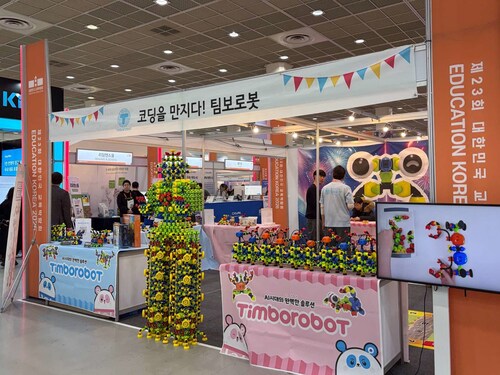
Timbo Robot is a thought-centered edutech solution born from these pedagogical concerns. By adopting Tangible User Interface (TUI)—or "Handheld Coding"—it enables children to instantly manifest imagination through physical manipulation. The "Memory & Play" learning structure, where children assemble blocks and record motions directly, ensures a seamless connection between Thought–Action–Result, a vital pedagogical element that preserves uninterrupted cognitive flow.
Educational tools must be intuitive. Simplicity liberates thought, allowing children to express logic without burden and expand their creativity.
Eschewing rigid, wheel-based robots, Timbo Robot utilizes a modular, block-based system to minimize expressive constraints. This empowers children to design unique solutions and structures rather than merely following "correct answers."
Admittedly, the TUI method is not without its physical constraints, such as the difficulty of simultaneous multi-action input or potential timing discrepancies during complex sequences. To overcome these challenges, Timbo Robot introduces a next-generation hybrid coding solution. This system groups motion blocks via wireless technology and integrates with various sensors and smart devices, allowing for seamless expansion into digital block coding. This approach retains the intuitive advantages of TUI and kinesthetic learning, while addressing the previous limitations in precision control and complex system implementation.
From Geometric Design to Physical Causality: Completing Creative Problem-Solving
For instance, implementing typical quadrupedal robots requires high-level mathematical analysis, such as Kinematics and Dynamics. This presents a formidable entry barrier not only for children but also for non-experts. Timbo Robot substitutes this complex mathematical interpretation with a TUI-based method of "direct motion input by hand," enabling children to naturally grasp locomotion principles and system architectures. Furthermore, through sensor integration and block coding, anyone can design and control complex systems in a step-by-step manner.
Additionally, Timbo Robot's proprietary pincer-type connection enables seamless rotation and infinite expansion, designed based on the Fibonacci ratio. This structure is optimized for biomimicry while engaging in creative activities, helping children instinctively understand natural order and forms through play. Grounded in geometric principles starting from the "line" concept (within the point-line-plane progression), the assembly process ensures children naturally internalize mathematical concepts while creating various shapes and structures.
Throughout the process of assembling Timbo Robot and implementing locomotion, children experience firsthand the fact that movement varies according to block weight, size, and connection structure. The iterative trial-and-error process—repeatedly attempting and refining movements to create better motion—serves as a powerful learning experience that helps children, who are accustomed to virtual spaces within smartphones, understand the physical environment and causal relationships of the real world.
Timbo Robot is more than a mere robot toy; it is a comprehensive educational solution that encompasses the entire process of structuring thought, implementing it by hand, and solving problems through failure and revision. Timbo's technology and philosophy lie in nurturing the thinking skills essential for navigating the future, in the most 'child-like' manner possible.
About Timbo Robot
Timbo Robot is a pioneering edutech leader dedicated to fostering non-cognitive growth through intuitive, play-based exploration. By bridging physical action and logical thinking, Timbo Robot empowers children to develop essential life skills—such as persistence and curiosity—without the burden of complex syntax. Our solution prioritizes a seamless creative flow, giving immediate shape to a child's imagination through three core pillars:
- Screen-Free Tangible Coding (TUI): We eliminate digital distractions through a hands-on interface. By recording motions directly by hand, children experience an immediate connection between thought and action, fostering self-confidence through active, physical engagement.
- Fibonacci-Inspired Geometric Logic: Our modular blocks, designed based on the Fibonacci ratio, enable children to instinctively internalize mathematical order. Through open-ended creative play, they master complex structures by following the natural laws of geometry.
- Resilience through Physical Trial & Error: By navigating sensor-driven cause and effect, children learn that every challenge is a step toward discovery. This iterative process builds the grit and adaptive problem-solving skills essential for navigating a complex future.
Media Contact
JongTae Kim, Timborobot, 82 -70-7874-1013~5, [email protected], https://timbo.co.kr/
SOURCE Timbo Robot

Share this article