
Human Driven AI's inaugural AI Adoption Gap Report chronicles how enterprise AI evolved from 2023 to 2026, and why the next competitive advantage isn't AI adoption.
ATLANTA, July 27, 2026 /PRNewswire-PRWeb/ -- Human Driven AI didn't set out to discover an organizational adaptation problem. The company planned to answer a much simpler question: How are employees adopting AI? Three years later, the research arrived at a very different conclusion. Employees had already changed. Organizations hadn't.
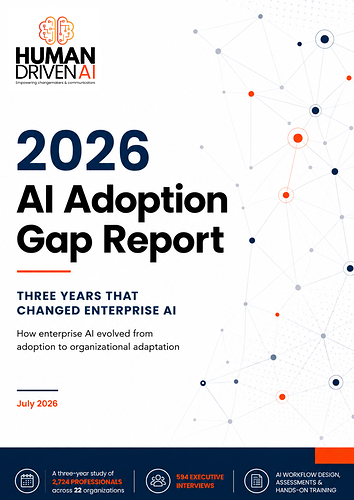
That unexpected discovery became the foundation for the 2026 AI Adoption Gap Report, a three-year study documenting how enterprise AI evolved between 2023 and 2026.
Unlike traditional reports that capture a single moment in time, this research followed AI as it moved from curiosity to routine work, from individual experimentation to organizational change and from technology adoption to leadership adaptation.
Because the research followed organizations over three years, it also captured something most AI studies cannot: how the conversation itself changed. The questions leaders asked in 2023 were fundamentally different from those they asked in 2024, 2025 and 2026. That evolution became one of the report's most revealing findings, documenting how enterprise AI matured from a technology discussion into an organizational one.
The findings draw on research involving 2,724 professionals, 594 executive interviews, AI-assisted workflow design, organizational assessments, and hands-on training and implementation across 22 enterprise organizations.
As those years unfolded, the questions leaders asked changed dramatically. The conversation began with whether employees should use AI. It shifted to which tools organizations should adopt. Today, it has moved beyond technology altogether to how work itself must change.
The report's central finding is simple: Organizations aren't struggling to get employees to adopt AI. They're struggling to adapt to a workforce that already has.
"Because we weren't just surveying people, we were working alongside them, we had a front-row seat to one of the fastest workplace transformations in modern history," said Jennifer Jones-Mitchell, Founder and CEO of Human Driven AI. "That allowed us to observe not just what organizations were doing, but how their thinking evolved over time."
The report explores some of the most important questions facing enterprise leaders today, including:
- Why are employees adopting AI faster than organizations?
- What happens after AI adoption?
- Why doesn't high AI usage automatically create organizational capability?
- What does organizational adaptation actually look like?
- What will define the next competitive advantage?
The report also examines how enterprise AI evolved from isolated productivity gains into a broader shift in workflow design, governance, leadership, accountability and organizational capability.
Among the report's current findings:
- 85% of professionals surveyed in 2026 actively use AI in their work.
- 19 of 22 organizations studied raised concerns about AI governance and responsible use.
- AI has moved beyond technology adoption to reshaping how organizations work.
- Better organizational design, not better AI, will separate the leaders from the rest.
The report argues that enterprise AI has entered a new chapter. The first chapter asked whether employees would adopt AI. They did. The next chapter asks whether organizations can redesign themselves around a workforce that already has.
"The organizations succeeding aren't eliminating people. They're redefining roles," said Jones-Mitchell. "The answer was never to resist AI. It's to help employees learn to work alongside it. It comes down to this. The companies that pull ahead won't simply have better AI. They will build better organizations around how humans and AI work together."
That shift, from managing tools to redesigning how people work, is where the report ultimately leads.
The full 2026 AI Adoption Gap Report provides a roadmap for leaders navigating AI's next chapter: one in which competitive advantage depends less on AI adoption and more on redesigning how people and AI work together.
Download the report: https://humandrivenai.com/download-the-2026-ai-adoption-gap-report/
About Human Driven AI
Human Driven AI is an AI training, consulting, and organizational transformation firm that helps you intentionally design how humans and artificial intelligence work together. Through AI readiness research, governance, workflow integration and custom AI trainings, we help you move beyond experimentation to build practical, scalable Human + AI By DesignÔ operating models. For more information, visit humandrivenai.com; connect with us on LinkedIn.
Media Contact
Katherine Morales, APR, Human Driven AI, 1 (404) 913-5655, [email protected], https://humandrivenai.com/
SOURCE Human Driven AI

Share this article