
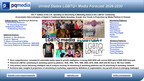
United States LGBTQ+ advertising and marketing spending is expected to rise only 2.2% in 2025 to $11.73 billion, decelerating from the 5.6% gain registered in 2024 when political campaigns targeted LGBTQ+ voters in swing states, according to new research released today by PQ Media, the world's leading provider of media econometrics.
STAMFORD, Conn., Dec. 9, 2025 /PRNewswire-PRWeb/ -- United States LGBTQ+ advertising and marketing spending is expected to rise only 2.2% in 2025 to $11.73 billion, decelerating from the 5.6% gain registered in 2024 when political campaigns targeted LGBTQ+ voters in swing states, according to new research released today by PQ Media, the world's leading provider of media econometrics. LGBTQ+ media accounted for only 1.57% of the $746.68 billion advertising & marketing industry in 2025, down from an 1.75% share in 2020, according to PQ Media's United States LGBTQ+ Media Forecast 2026-2030.
For much of the 21st century LGBTQ+ media had been outpacing overall advertising & marketing growth, including during the two recessions in 2008-09 and 2020. However, brands began to pull back support of LGBTQ+ events, like PRIDE parades, in 2023 following the controversial boycott of Bud Light after it used a transgender actor in its Super Bowl ad. For example, organizations that run PRIDE festivals reported significant declines in corporate sponsorships in 2023 and 2024, which weakened in 2025 due to political pressure on companies to disband their diversity, equity & inclusion (DEI) programs.
"We have been monitoring the LGBTQ+ media market for years and decided it was imperative to finally publish the first-ever report on LGBTQ+ media in 2025 after hearing from multiple key LGBTQ+ stakeholders that the market has tightened due to the current political climate as regards DEI. Key LGBTQ+ stakeholders shared their views with PQ Media regarding the future of this market, and their outlook is not optimistic in the short-term, said PQ Media CEO & Founder Patrick Quinn. "We expected a slight acceleration in growth in 2026 due to the influx of political media buying, particularly in states with contentious Senate and House races, but our Global Opinion Leader Panel is predicting almost flat growth until 2028."
Meanwhile, magazine publishers are reporting that alcohol brands have completely stopped advertising in LGBTQ+ titles since the Bud Light boycott after being the second largest industry vertical behind pharma for decades. This has been especially frustrating to LGBTQ+ media operators who have argued that their buying power is close to $2 trillion in 2025. Furthermore, LGBTQ+ individuals over-index in purchasing cars, electronics, fashion, financial services and travel, among others. The LGBTQ+ community has favorable demographics that brands often target, such as skewing younger than the general population, more likely to be female, and be located in major metros like New York, Los Angeles and San Francisco, according to PQ Media.
Most LGBTQ+ media was covert for much of history, such as secretive direct mail campaigns during the Revolutionary War recruiting new members for "The Public Universe Friend" societies around the country, as well as direct mail invitations to "Drag Balls" being held in major cities like New York soon after the Civil War. The first efforts to conduct public advertising & marketing campaigns began around the mid-1920s when the first LGBTQ+ organization, Society for Human Rights, was formed in Chicago and recruiting members via direct mail campaigns and consumer events, while concurrently New York City nightclubs were touting leading LGBTQ+ blues singers in out-of-home posters during the "Harlem Renaissance."
LGBTQ+ media generated approximately $2 million nationwide in 1925, representing just 0.06% of overall ad & marketing. Almost 98% of that spending was in marketing media platforms, like branded entertainment, promotional marketing, direct marketing, and content marketing, with out-of-home media being the only advertising platform used.
By 1950, LGBTQ+ media had yet to exceed $10 million due to extremely restrictive laws and regulations. However, by 1975 LGBTQ+ media exceeded $150 million as select brands began to advertise in the plethora of magazines that sprung up after the Compton Cafeteria Riots and Stonewall Uprising of the 1960s, as well as brand licensing of LGBTQ+ inspired logos and phrases that came out of those two events. By 1990, LGBTQ+ spending was nearly $600 million, driven by the development of the PRIDE parades and festivals after the assassination of Harvey Milk, an openly gay member of the San Francisco Board of Supervisors.
AIDS led to a spending surge by healthcare organizations, which propelled LGBTQ+ spend to over $2 billion by 2000. As more LGBTQ+ characters began to be cast in TV shows and movies, brands became more comfortable developing LGBTQ+ campaigns for the key 14 media platforms by 2020, driving spending up to $8 billion, according to the United States LGBTQ+ Media Forecast 2026-2030.
In 2025, marketing media is the larger of the two LGBTQ+ media sectors, reaching $8.30 billion, a 70.7% share, posting a meager 1.9% growth rate. Advertising media will post stronger growth in 2025, rising 2.9% to $3.43 billion, according to PQ Media. Digital marketing is the largest of the 14 LGBTQ+ media platforms, reaching $2.37 billion in 2025, as well as the fastest growing, up 12.4%. Television is the largest of the eight advertising media at $1.91 billion, while digital advertising was the fastest growing, registering a 9.7% gain in 2025. Experiential marketing is largest of the 42 LGBTQ+ media channels that PQ Media covered in the report, reaching $1.80 billion in 2025, while streaming video advertising posted the highest growth, surging 29.6%.
For much of its history, LGBTQ+ media buying has been endemic and local in nature. But that has changed since the 1980s when brands, such as Absolut Vodka, began placing ads in national magazines and companies like IKEA were placing ads in TV programs with LGBTQ+ characters, such as Modern Family.
About the Report:
PQ Media's new United States LGBTQ+ Media Forecast 2026-2030 is the only credible source to comprehensively research, develop and deliver consistent and actionable LGBTQ+ media definitions, segmentation, spending data, growth drivers, and five-year growth projections across the LGBTQ+ media market. This groundbreaking report provides in-depth coverage of 14 LGTBTQ+ media platforms, including 8 advertising and 6 marketing platforms, as well as 42 media channels and 2 major media buying categories: endemic vs. non-endemic, and local vs. national.
The new Forecast marks the most in-depth examination of the domestic LGBTQ+ media market ever done, highlighting the largest and fastest-growing media platforms and channels, while delivering exclusive strategic intelligence covering the entire 2020-2030 period. Also included in the report is a 100-history of the 14 LGBTQ+ media platforms from 1925-2025, in 10-25 year increments. Click the following link to download a FREE Executive Summary (with full Table of Contents) and Sample Datasets from the new report: United States LGBTQ+ Media Forecast 2026-2030.
About PQ Media:
PQ Media delivers intelligent data and analysis to leading media and technology organizations worldwide through annual market intelligence reports and custom market research services. PQ Media uses a proprietary econometric methodology to define, segment, size, analyze and project growth across over 300 traditional, digital & alternative media, which are covered in our annual Global Media Forecast Series, a three-report package delivering the only holistic view of the industry landscape via three KPIs: ad & marketing spending, consumer media usage, and consumer media spend.
Media Contact
Patrick Quinn, PQ Media, 1 2039215249, [email protected], https://www.pqmedia.com
Leo Kivijarv, PhD, PQ Media, 1 2039215249, [email protected], https://www.pqmedia.com
SOURCE PQ Media


Share this article