When it comes to purchasing luxury property, lifestyle remains the primary motivation, but wealth preservation is the underlying driver. This motive is most pronounced amongst affluent property owners with internationally varied portfolios, with geography emerging as an even more significant factor than the asset class itself.
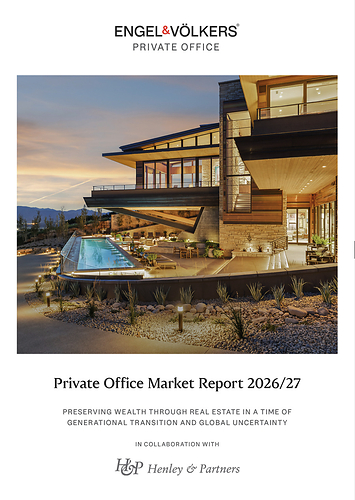
HAMBURG, Germany, Nov. 24, 2026 /PRNewswire-PRWeb/ -- When it comes to purchasing luxury property, lifestyle remains the primary motivation, but wealth preservation is the underlying driver, as the second "Engel & Völkers Private Office Market Report 2026/27" reveals. "Generational transition, global wealth mobility, and dynamic geopolitical and economic environments are influencing how (ultra-) high-net-worth individuals think about where they live, invest and establish their long-term foundations," Till-Fabian Zalewski, Group Co-CEO of Engel & Völkers, explains. "Against this backdrop, real estate is taking on a broader role – connecting lifestyle and personal aspirations with considerations around family, continuity and long-term security." This motive is most pronounced amongst affluent property owners with internationally varied portfolios, with geography emerging as an even more significant factor than the asset class itself.
The report draws on insights from 185 Engel & Völkers Private Office advisors operating in 17 countries worldwide and incorporates selected insights from Henley & Partners' Global Wealth Mobility Framework across six key markets. The framework assesses the structural attractiveness and competitiveness of jurisdictions for internationally mobile wealth across 12 weighted dimensions, including tax treatment, rule of law and quality of life, residence and citizenship pathways, geopolitical stability and capital mobility. "Property is often one of the most visible elements of an internationally mobile family's global footprint, but it increasingly sits within a much broader set of decisions about where to live, establish rights, educate children, conduct business and preserve future options," says Dominic Volek, Group Head of Private Clients at Henley & Partners. "Wealthy families are thinking less in terms of one alternative destination and more in terms of complementary jurisdictions that can serve different purposes over time."
Preservation Motive Strongest Where Portfolios Cross Borders
While the most affluent tend to describe their property choices as lifestyle-oriented, the report shows that the predominant motivation lies somewhere else. "A compelling distinction emerged between how clients describe their real estate decisions and what may ultimately be driving them. Lifestyle remains a powerful consideration, but wealth preservation plays a greater role than clients may explicitly articulate," says Stuart Siegel, Global Head of Engel & Völkers Private Office. "The dynamic is even more pronounced among clients whose real estate holdings span multiple countries." As the report shows, the prevalence of this motive increases from approximately one third of transactions among clients with domestic holdings to nearly two thirds among those with properties throughout multiple jurisdictions.
External factors are affecting purchasing decisions nearly as strongly as personal preferences with more than approximately 70 percent of advisors describing their clients exhibiting elevated caution in light of global uncertainty. With generational wealth transfer underway, approximately one quarter of transactions is being influenced by considerations around family, leaving the global luxury market to evolve in a measured manner.
Geography Becoming More Significant than Asset Class for Portfolio Architecture
As current market forces indicate a divergence in pace, geography emerges as an increasingly important factor. Engel & Völkers Private Office research points to stronger property-market momentum across Southern European and Alpine markets, including Switzerland, Greece, Spain, and Italy, while the United States and Canada are both characterized by a more measured approach. At the same time, Henley & Partners' Global Wealth Mobility Framework highlights differing structural strengths and pressures across the six jurisdictions, with each receiving a high valuation in terms of wealth mobility competitiveness.
Outlook: Purchasing Motivation Increasingly Influenced by External Factors
The global experts at Engel & Völkers Private Office anticipate that luxury property continues to be valued for its dual role in enabling a desired lifestyle and supporting long-term wealth preservation, a perspective that remains consistent regardless of prevailing market conditions. "Geopolitical instability, tax and regulatory considerations, and generational planning are becoming progressively intertwined with real estate decisions", explains Siegel. "Navigating this environment requires more than knowledge of individual markets. It calls for a truly global perspective and a nuanced understanding of the forces shaping the decisions of this distinctive clientele," concludes Zalewski.
The full report with detailed country insights, forecasts and wealth mobility data is available for download here: "Engel & Völkers Private Office Global Market Report 2026/27".
Media Contact
Mareike Frye, Engel & Völkers Holding GmbH, 49 152 03028663, [email protected], https://www.engelvoelkers.com/private-office/en
SOURCE Engel & Völkers Holding GmbH

Share this article